


When to Take One and What Your Results May Mean.
Feeling sad occasionally is part of being human. Difficult days, disappointment, relationship problems, financial worries, grief and everyday stress can all affect how we feel.
But what happens when feeling low doesn’t seem to pass?
What if activities you once enjoyed no longer feel enjoyable? What if you’re constantly tired, struggling to concentrate, withdrawing from people or finding everyday responsibilities increasingly difficult?
Sometimes depression develops gradually enough that it can be difficult to recognize.
You might know that something feels different without being able to explain exactly what has changed.
This is one situation in which an online depression test may be useful.
A depression test or questionnaire can help you reflect systematically on symptoms you’ve been experiencing and consider whether it would be appropriate to seek further support.
It is important to understand, however, that an online depression test is not a diagnosis. Depression should be assessed and diagnosed by an appropriately qualified healthcare or mental-health professional.
Think of an online test as a starting point: something that can encourage reflection and help you decide what to do next.
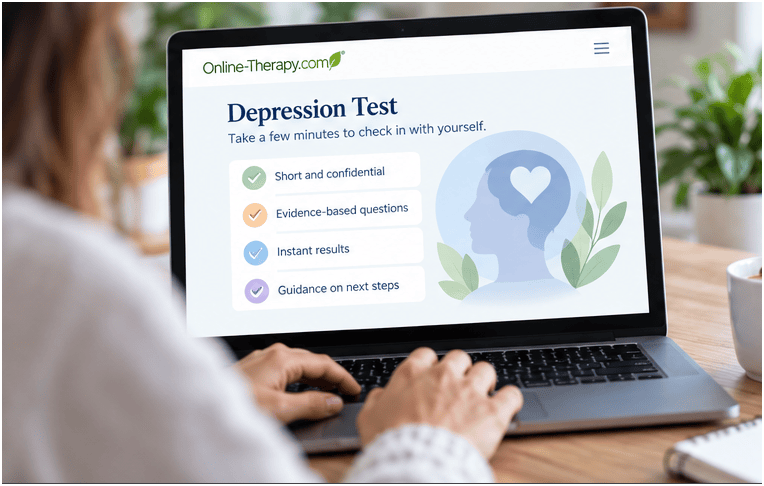
Take the Online-Therapy.com Depression Test:
What Is Depression?
Depression is more than simply having a bad day or occasionally feeling sad.
It can affect your emotions, thoughts, behavior, motivation, relationships, sleep, appetite, concentration and ability to function in everyday life.
Two particularly well-known features are a persistent low mood and a reduced ability to experience interest or pleasure in activities.
Someone experiencing depression may feel sad, empty, discouraged or hopeless.
But depression doesn’t necessarily look the same in everyone.
Some people may experience considerable sadness. Others describe feeling emotionally numb or disconnected.
Someone might become irritable rather than obviously sad.
Another person may continue going to work, socializing and fulfilling responsibilities while privately struggling with significant symptoms.
That’s one reason depression can sometimes go unrecognized.
What Are Common Signs and Symptoms of Depression?
Depression can involve emotional, cognitive, behavioral and physical symptoms.
Recognizing individual symptoms doesn’t automatically mean you have depression. Many of these experiences can occur temporarily for numerous reasons.
However, when several symptoms persist, occur frequently or begin interfering with everyday functioning, they deserve attention.
Persistent Sadness or Low Mood
One of the most recognizable symptoms is an ongoing feeling of sadness.
You may feel low for much of the day or find that the feeling repeatedly returns.
Sometimes there is an obvious reason.
Sometimes there isn’t.
You might even find yourself wondering, “Why do I feel like this when nothing particularly bad has happened?”
Depression doesn’t always require an obvious external cause.
Losing Interest in Things You Normally Enjoy
Another important symptom is a loss of interest or pleasure.
Activities that previously made you happy may begin feeling uninteresting or require too much effort.
You may stop pursuing hobbies.
You might avoid seeing friends.
Music, entertainment, exercise, intimacy or social activities may no longer provide the enjoyment they once did.
This loss of pleasure can sometimes be more noticeable than sadness itself.
Feeling Empty, Hopeless or Discouraged
Depression can influence how you perceive yourself, your circumstances and the future.
You might feel as though things aren’t going to improve.
Problems that once seemed manageable may begin to feel overwhelming.
Thoughts such as:
“Nothing is going to change.”
“What’s the point?”
or
“Things will always be like this.”
may become increasingly frequent.
These thoughts can feel convincing when you’re experiencing them, which is one reason outside support can be valuable.
Changes in Sleep
Depression can affect sleep in different ways.
Some people have difficulty falling asleep or wake repeatedly throughout the night.
Others wake unusually early and can’t return to sleep.
Some experience the opposite problem and sleep significantly more than usual.
Even after spending many hours in bed, they may still feel exhausted.
If your sleeping pattern has changed significantly alongside changes in mood, motivation or enjoyment, it is worth paying attention to the overall pattern.
Fatigue and Low Energy
Depression can make ordinary activities feel unusually difficult.
Getting out of bed, taking a shower, answering messages, preparing food or going to work may require far more effort than they normally would.
This can be confusing, particularly when you can’t identify an obvious physical reason for feeling exhausted.
Low energy can also contribute to a difficult cycle.
When you feel exhausted, you may do less.
Doing less can reduce opportunities for enjoyment, social interaction and accomplishment.
That can potentially reinforce low mood.
Difficulty Concentrating or Making Decisions
Depression doesn’t only affect emotions.
It can also affect thinking.
You may have trouble concentrating on work, reading, conversations or television.
Simple decisions can begin to feel unexpectedly difficult.
You might read the same paragraph several times without absorbing it or find yourself staring at an email because you can’t decide how to respond.
These changes can sometimes be mistaken for laziness or lack of motivation when they’re occurring alongside other depressive symptoms.

Changes in Appetite
Some people experiencing depression notice significant changes in appetite or eating habits.
You may eat considerably less because food seems unappealing.
Alternatively, you might eat more than usual, perhaps turning to food for comfort.
Appetite and weight changes can have many possible causes, so they shouldn’t be interpreted as evidence of depression by themselves.
But they can form part of the broader picture.


Leave a Reply