


Understanding the Theory, Process and Benefits of Cognitive Behavioral Therapy
If you’ve never tried therapy before, the idea can feel surprisingly mysterious.
What actually happens?
Do you simply talk about your problems?
Does a therapist tell you what to do?
How can completing exercises or discussing your thoughts change the way you feel?
And perhaps most importantly:
How can therapy delivered online actually help?
To answer those questions, it helps to understand the theory behind one of the most widely used psychological approaches: Cognitive Behavioral Therapy (CBT).
Online-Therapy.com’s program is built around CBT principles. At its simplest, CBT explores the relationships between your thoughts, emotions and behaviors and helps you identify patterns that may be contributing to psychological distress.
The central idea is surprisingly practical.
What happens to us matters, but the way we interpret situations—and the way we respond to those interpretations—can also have a powerful influence on how we feel and what happens next.
By learning to recognize these patterns, examine unhelpful thoughts and gradually change behaviors, you can work toward responding to life’s challenges differently.
That doesn’t mean simply “thinking positively.”
It means learning to identify patterns, test assumptions and develop more flexible and useful responses.
Learn how Online-Therapy.com works:
https://www.online-therapy.com/how_it_works.php
What Is Cognitive Behavioral Therapy?
Cognitive Behavioral Therapy is a structured form of psychological therapy.
The name contains two important ideas:
Cognitive refers to thoughts, beliefs, assumptions and interpretations.
Behavioral refers to actions, reactions, avoidance, habits and other patterns of behavior.
CBT examines how these areas interact with emotions and physical sensations.
Imagine you send a friend a message.
Several hours pass and they don’t respond.
That’s the situation.
Now imagine two different interpretations.
Interpretation One
“They’re probably busy. They’ll reply later.”
You continue with your day.
Interpretation Two
“They’re ignoring me. I must have said something wrong. Maybe they’re angry with me.”
You feel anxious.
You reread your previous messages.
You send another text.
Then another.
You spend the evening worrying about the relationship.
The external event is identical in both examples:
Your friend hasn’t replied yet.
But the interpretation creates a very different emotional and behavioral response.
CBT is interested in this relationship.
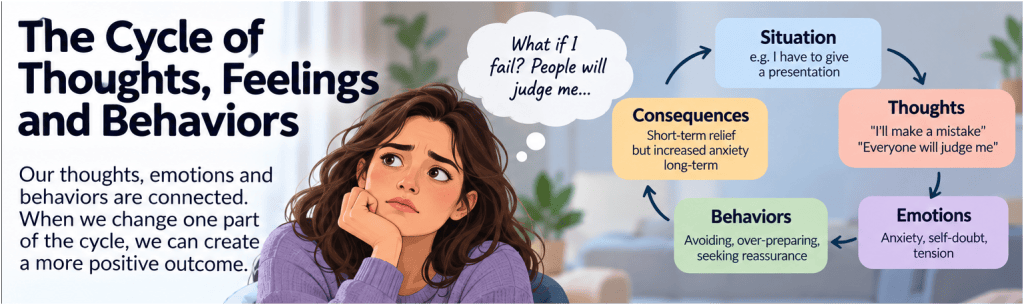
The Basic CBT Model
A simplified CBT model might look like this:
Situation → Thoughts → Emotions → Behaviors → Consequences
In reality, the relationships can move in several directions.
Your behavior can influence your thoughts.
Your physical sensations can influence your emotions.
Your emotions can change the way you interpret a situation.
Your environment can influence everything.
The important idea is that these elements are interconnected.
If you can identify where an unhelpful cycle is occurring, you may have opportunities to change it.
Why Do Our Thoughts Matter?
People sometimes misunderstand CBT as saying:
“Everything is in your head.”
That isn’t the point.
Real problems exist.
People experience loss, discrimination, illness, relationship difficulties, financial problems, trauma and countless other genuine challenges.
CBT doesn’t require pretending that difficult circumstances are good.
Instead, it asks:
What thoughts are occurring in response to this situation, and are those thoughts helping you understand and respond to it accurately?
Suppose you make a mistake during a presentation.
You might think:
“I made a mistake.”
That’s factual.
But your mind might continue:
“Everyone thinks I’m incompetent.”
“I’ve ruined my career.”
“I should never speak in public again.”
Those additional conclusions aren’t necessarily facts.
They’re interpretations.
CBT can help you learn to recognize the difference.
Automatic Thoughts
Many thoughts occur so quickly that we barely notice them.
These are sometimes called automatic thoughts.
Imagine walking into a party where you don’t know many people.
Before you’ve consciously analyzed the situation, your mind may produce:
“Nobody will talk to me.”
You feel anxious.
Because you’re anxious, you stand in the corner and look at your phone.
Few people approach you.
At the end of the evening, you think:
“I knew nobody wanted to talk to me.”
But notice what happened.
The original prediction influenced your behavior.
Your behavior may then have influenced the social response you received.
The thought appeared to prove itself.
CBT can help make these cycles visible.
Thoughts Are Not Automatically Facts
This is one of the most useful principles behind CBT.
A thought can feel convincing without necessarily being accurate.
Consider thoughts such as:
“I’m going to fail.”
“Nobody likes me.”
“I can’t cope with this.”
“Something terrible is going to happen.”
“I’ll never feel better.”
When you’re anxious or depressed, thoughts like these can feel completely true.
CBT doesn’t ask you to replace them with unrealistic statements such as:
“Everything will be perfect.”
Instead, you learn to investigate them.
What evidence supports this thought?
What evidence doesn’t?
Am I predicting the future?
Am I assuming I know what another person thinks?
Am I treating one negative experience as proof of a permanent pattern?
Is there another explanation?
What would I say to a friend who had this thought?
This process can help create a more balanced interpretation.
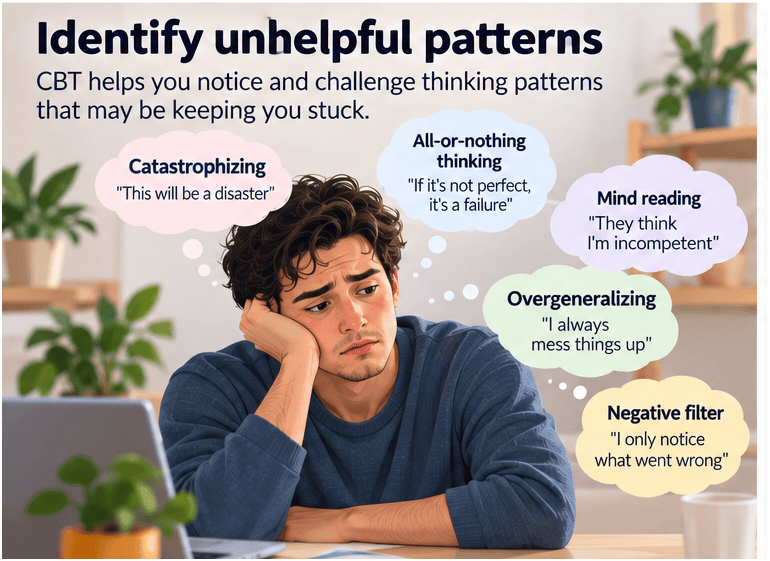
Cognitive Distortions and Unhelpful Thinking Patterns
Over time, people can develop recurring thinking styles that contribute to distress.
For example, you might interpret situations in all-or-nothing terms.
Either something is perfect or it’s a complete failure.
You may catastrophize, automatically imagining the worst possible outcome.
You might assume you know what other people are thinking.
Or you may focus intensely on negative information while discounting anything positive.
CBT helps you become more aware of these patterns.
Importantly, the objective isn’t to monitor every thought you have.
It’s to recognize recurring patterns that contribute to distress or interfere with your life.
Why Behavior Matters Just as Much as Thinking
CBT isn’t only about changing thoughts.
Behavior can be equally important.
Imagine someone experiencing social anxiety.
They believe:
“If I go to the party, I’ll embarrass myself.”
So they stay home.
Their anxiety immediately decreases.
That relief feels good.
But their brain may learn:
“Avoiding the party kept me safe.”
The next social event becomes even more intimidating.
This illustrates how avoidance can maintain anxiety.
Short-term relief can sometimes produce a longer-term problem.
Behavioral work in CBT can therefore involve gradually changing avoidance patterns and testing predictions through real-world experience.
The Relationship Between Thoughts, Feelings and Behaviors
Consider another example.
Situation
Your manager asks to speak with you tomorrow morning.
Thought
“I’m going to be fired.”
Emotion
Anxiety.
Physical response
Racing heart, muscle tension and difficulty sleeping.
Behavior
You repeatedly review everything you’ve done at work, ask colleagues for reassurance and spend hours imagining the meeting.
Consequence
You’re exhausted the following morning and even more anxious.
The original situation contained relatively little information.
Your manager simply asked for a meeting.
The interpretation generated much of the emotional response.
CBT can help you identify the thought and ask whether alternative interpretations exist.
Maybe your manager wants an update.
Perhaps there’s a new project.
Maybe the meeting concerns scheduling.
You don’t need to convince yourself that the meeting will definitely be positive.
You can learn to tolerate the uncertainty without automatically treating the worst-case scenario as fact.
Why CBT Uses Exercises and Worksheets
Understanding something intellectually doesn’t always change behavior.
You may already know that worrying doesn’t solve every problem.
You may know that avoiding social situations reinforces fear.
You might know that harsh self-criticism isn’t helping.
Yet the pattern continues.
That’s why CBT often involves active practice.
Worksheets, journals and structured exercises can help you slow down experiences that normally happen automatically.
Instead of:
Situation → anxious thought → reaction
you begin creating space:
Situation → notice thought → examine thought → consider alternatives → choose response
With repetition, this process can become more familiar.
How Does Online CBT Work?
Traditional CBT is often delivered through face-to-face sessions.
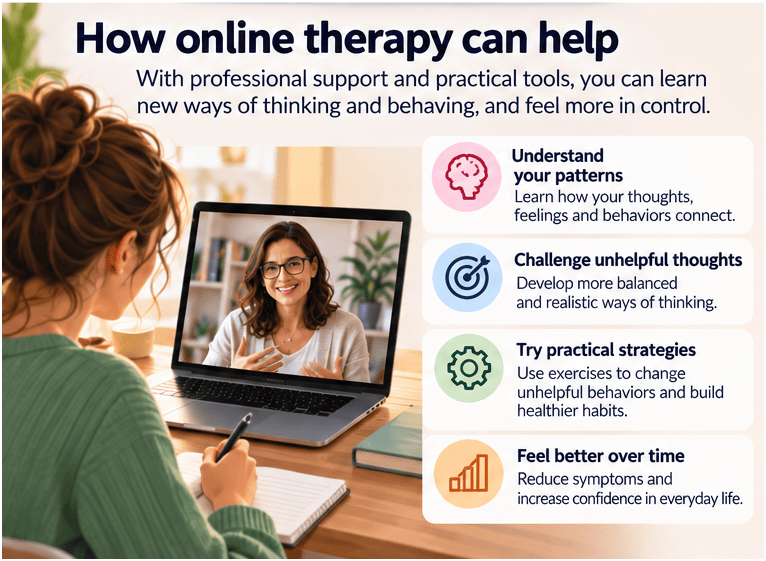
Online therapy applies therapeutic principles through digital communication and structured online tools.
Online-Therapy.com’s program is based on CBT and combines online therapeutic resources with professional therapist support.
Depending on the applicable service and plan, this may involve structured sections, worksheets, therapist feedback, messaging, journaling and live therapy sessions.
The digital format can allow therapeutic work to continue between scheduled interactions.
Rather than thinking about therapy only during an appointment, you can potentially work on exercises while the relevant situations are still fresh in your mind.
Step 1: Understanding the Problem
Effective therapy usually begins with understanding what is happening.
What difficulties are you experiencing?
When do they occur?
What situations trigger them?
What thoughts appear?
How do you respond?
What happens afterward?
Imagine someone experiencing panic.
Their pattern might look like:
Situation: Heart begins beating quickly.
Thought: “I’m having a heart attack.”
Emotion: Fear.
Physical response: Increased arousal.
Behavior: Escape and seek reassurance.
Consequence: Temporary relief, followed by increased fear of future bodily sensations.
Mapping the cycle can make something that previously felt chaotic easier to understand.
Step 2: Identifying Patterns
Once you begin recording experiences, patterns may emerge.
Perhaps anxiety is particularly strong before meetings.
Maybe low mood is worse after spending an entire day alone.
You may discover that checking behaviors increase whenever you’re stressed.
Perhaps insomnia becomes worse after you start monitoring the clock.
Patterns provide useful information.
Instead of thinking:
“I feel terrible for no reason,”
you may begin recognizing relationships between particular situations, thoughts, behaviors and emotional responses.
Awareness doesn’t automatically solve the problem, but it creates opportunities for change.
Step 3: Examining Your Thoughts
The next stage may involve learning to examine thoughts rather than automatically accepting them.
Suppose you make a small mistake at work.
Your automatic thought is:
“I’m useless.”
A CBT exercise might encourage you to examine that conclusion.
What actually happened?
You made one mistake.
Does one mistake prove that you’re useless?
Have you completed other tasks successfully?
Would you describe a colleague as useless because of one error?
Could a more balanced thought be:
“I made a mistake. I don’t like making mistakes, but I can correct it and learn from it.”
Notice that this isn’t forced positivity.
The mistake is still acknowledged.
The interpretation simply becomes more proportionate.
Step 4: Changing Behavior
Sometimes changing behavior is more powerful than debating thoughts endlessly.
Someone experiencing depression may think:
“I don’t feel like doing anything.”
They withdraw from activities.
That withdrawal reduces opportunities for achievement, pleasure and social connection.
Mood may fall further.
CBT can involve gradually reintroducing meaningful activities even before motivation has fully returned.
Someone with anxiety may work on reducing avoidance.
A person with OCD may work on resisting compulsions through an appropriately designed treatment such as Exposure and Response Prevention.
The behavioral strategy depends on the problem being addressed.
Step 5: Practicing New Skills in Everyday Life
Therapy isn’t only about what happens between you and a therapist.
The real test occurs outside the session.
Can you recognize an automatic thought during a stressful workday?
Can you respond differently when anxiety encourages avoidance?
Can you notice when you’re catastrophizing?
Can you use a healthier coping strategy when you’re upset?
Skills become more useful when they can be applied in ordinary situations.
Online therapy can be well suited to this process because structured resources may remain accessible while you’re working through everyday challenges.
Step 6: Learning From Experience
CBT often treats real-life experience as information.
Suppose you predict:
“If I speak during the meeting, everyone will think I’m stupid.”
You decide to contribute one comment.
Nobody laughs.
Someone responds positively.
Your original prediction now has new evidence against it.
One experience may not completely change a deeply held belief.
But repeated experiences can gradually weaken assumptions that previously felt certain.
Behavioral experiments can therefore become an important part of CBT.
Why Can Online Therapy Be Effective for Some People?
Convenience is one obvious advantage.
Traveling to appointments requires time.
Work schedules can make regular office visits difficult.
Some people live far from appropriate services.
Others simply feel more comfortable beginning therapy from home.
Online therapy can remove some of these practical barriers.
But convenience isn’t the only potential advantage.
Because CBT involves observation and practice, digital tools can make it easier to record experiences and work through exercises in the environment where problems actually occur.
You don’t necessarily have to remember on Friday exactly what you were thinking during an anxious moment on Monday.
You may be able to record the experience closer to when it happened.
When Should You Consider Online Therapy?
There isn’t a universal threshold.
You don’t have to wait until you’re unable to function.
Therapy may be worth considering when thoughts, emotions or behaviors repeatedly interfere with your wellbeing or the life you want to live.
For example, you might consider professional support if anxiety is controlling your decisions, low mood persists, compulsions consume significant time, panic is causing avoidance, trauma-related symptoms continue affecting you, sleep difficulties are disrupting daytime functioning, or relationship and emotional problems repeatedly follow the same pattern.
You can also seek therapy simply because you want to understand yourself better.
Therapy isn’t reserved exclusively for crises.
CBT for Anxiety
Anxiety often involves predictions about future danger.
“Something will go wrong.”
“I won’t cope.”
“Everyone will judge me.”
“I’ll lose control.”
These thoughts may lead to avoidance, reassurance seeking, checking or other safety behaviors.
CBT can help identify those patterns and test predictions more realistically.
For some anxiety conditions, treatment may include appropriately planned exposure to feared situations.
The goal isn’t to eliminate every feeling of anxiety.
Some anxiety is useful.
The objective is to reduce the extent to which excessive anxiety determines your choices.
CBT for Depression
Depression can create cycles involving negative thoughts and withdrawal.
You feel low.
You stop doing things.
You experience fewer opportunities for pleasure or achievement.
You feel worse.
Thoughts such as:
“Nothing will help anyway”
may strengthen the cycle.
CBT may involve identifying negative thinking patterns while gradually increasing meaningful or rewarding activities.
Again, this isn’t about telling someone with depression to “think positively.”
It involves structured therapeutic work aimed at changing patterns associated with ongoing distress.
CBT for OCD
OCD provides another clear example of the relationship between thoughts and behaviors.
An intrusive thought appears.
Anxiety increases.
A compulsion is performed.
Anxiety temporarily decreases.
That relief reinforces the compulsion.
CBT for OCD often incorporates Exposure and Response Prevention (ERP), an evidence-based approach involving gradual exposure to appropriate triggers while reducing compulsive responses.
Specialized treatment should be delivered or guided by an appropriately qualified professional.
CBT for Insomnia
Persistent insomnia can also involve a self-reinforcing cycle.
You sleep poorly.
You worry about sleeping.
You spend longer in bed trying to compensate.
You monitor the clock.
Bed becomes associated with wakefulness and anxiety.
CBT for insomnia, often called CBT-I, addresses sleep-related thoughts and behaviors rather than focusing solely on general relaxation or basic sleep hygiene.
CBT and Trauma-Related Difficulties
Trauma can influence beliefs about safety, trust, responsibility and control.
A person may avoid reminders of the traumatic experience because avoidance reduces distress temporarily.
Trauma-focused CBT approaches can help some people process trauma-related experiences and beliefs in a structured way.
Trauma treatment needs to be appropriately paced and delivered with attention to safety and individual circumstances.
What CBT Is Not
Understanding what CBT doesn’t involve can be just as important.
CBT isn’t simply positive thinking.
It isn’t about blaming you for your problems.
It doesn’t claim that difficult circumstances aren’t real.
It doesn’t mean ignoring emotions.
And it isn’t a therapist telling you what you should think.
Good CBT is collaborative.
You and your therapist work together to understand patterns and test different ways of responding.
The aim is to help you develop skills that you can increasingly use independently.
Why the Therapist Still Matters in Online Therapy
Digital exercises can be useful, but therapy isn’t simply a collection of worksheets.
A therapist can help you understand which patterns are relevant, identify areas you may be overlooking and adapt therapeutic strategies to your situation.
They can also help you distinguish between productive therapeutic challenges and approaches that may be inappropriate.
This matters because different problems require different strategies.
A technique useful for one condition isn’t automatically suitable for another.
Personalization and professional judgment remain important.
How Long Does CBT Take?
There isn’t one universal answer.
CBT is often described as structured and goal-oriented, but the appropriate length of treatment varies.
It depends on the problem, symptom severity, treatment goals, other mental or physical health concerns, previous treatment and individual circumstances.
Some people work on a relatively specific problem.
Others have several interconnected difficulties requiring longer-term support.
Rather than focusing only on a predetermined number of sessions, it can be more useful to consider whether you’re making meaningful progress toward agreed goals.
What Does Progress Look Like?
Progress doesn’t necessarily mean never feeling anxious, sad, angry or stressed again.
Those emotions are part of life.
Progress may mean recognizing an anxious thought before automatically acting on it.
It may mean attending something you previously avoided.
Perhaps you recover from setbacks more quickly.
Maybe you become less dependent on reassurance.
You could become better at distinguishing thoughts from facts.
You may understand your emotional triggers more clearly.
What If Therapy Feels Difficult?
Therapy can sometimes be uncomfortable.
Examining thoughts and changing established behaviors may bring you into contact with feelings you’ve been avoiding.
That doesn’t mean every uncomfortable experience is automatically therapeutic, however.
You should be able to discuss concerns with your therapist.
A good therapeutic relationship allows questions such as:
Why are we doing this exercise?
What is the goal?
Is there another way to approach this?
How does this connect with my treatment plan?
Therapy should be collaborative rather than mysterious.
Understanding the theory behind an exercise can make it easier to engage with the process.
When Online Therapy May Not Be Appropriate
Online therapy can be useful, but it isn’t suitable for every circumstance.
Someone experiencing an immediate mental-health crisis may require urgent or in-person support.
Severe symptoms may sometimes require specialized treatment, medical assessment, psychiatric care or a higher level of care.
Physical symptoms may also need medical investigation rather than being assumed to have a psychological cause.
The appropriate form of support depends on the individual situation.
If you’re uncertain, speaking with an appropriately qualified healthcare or mental-health professional can help determine the next step.
Why Understanding the Theory Can Make Therapy More Useful
One of the strengths of CBT is that the theory can be applied outside therapy.
Once you understand the basic model, you can begin noticing it in everyday life.
Something happens.
You interpret it.
That interpretation produces an emotional response.
You behave in a particular way.
The behavior creates consequences.
You can then ask:
What happened?
What did I think?
How did that make me feel?
What did I do next?
Did my response help in the short term but create problems later?
Is there another way I could interpret or respond to this situation?
These questions transform you from a passive recipient of emotions into an active observer of patterns.
That doesn’t mean you can control everything you feel.
It means you can develop more choices in how you respond.
How Online-Therapy.com Fits Into This Approach
Online-Therapy.com’s program is based around Cognitive Behavioral Therapy.
Rather than treating therapy as something that exists only during an occasional conversation, the online model combines structured therapeutic work with professional support.
Depending on the relevant plan and program, users can work through online sections and exercises, communicate with a therapist and participate in live therapy sessions.
This structure can make therapy an ongoing learning process.
You can read about a concept.
Apply it to your own experience.
Record what happens.
Receive feedback.
Try a different response.
Then reflect on the result.
That cycle of learning, practice, feedback and adjustment reflects an important principle of CBT.
See how Online-Therapy.com works:
https://www.online-therapy.com/how_it_works.php
Explore the theory behind CBT:
https://www.online-therapy.com/cbt
Taking the First Step
You don’t need to understand psychology before beginning therapy.
You don’t need to know exactly why you feel the way you do.
And you don’t need to arrive with a perfect explanation of the problem.
Understanding can be part of the process.
Perhaps you’re dealing with anxiety.
Maybe you’re experiencing low mood.
You could be struggling with sleep, panic, intrusive thoughts, trauma-related symptoms, relationship difficulties or another emotional challenge.
The starting point is often curiosity:
What patterns are happening in my life, and could I learn a different way of responding to them?
CBT provides a structured framework for exploring that question.
Online therapy makes that framework accessible from home.
Ready to Learn More About How Online Therapy Works?
If you want to understand your thoughts, emotions and behaviors more clearly, exploring CBT-based online therapy may be a useful next step.
Online-Therapy.com provides structured online therapy based on CBT principles, designed to help users work through psychological challenges with professional support.
Discover how the program works:
Learn more about Cognitive Behavioral Therapy:
Therapy isn’t about becoming a person who never experiences difficult thoughts or emotions.
It’s about developing the awareness and skills to respond to them differently.
And sometimes, understanding the pattern is the first step toward changing it.
Important Information
This article is for general educational purposes and isn’t medical advice, psychological diagnosis or an individualized treatment plan. CBT can be helpful for a range of mental-health conditions, but the appropriate treatment depends on the person, symptoms, diagnosis and circumstances.
If you’re experiencing severe symptoms, an immediate mental-health crisis, thoughts of harming yourself or someone else, or another emergency, seek urgent help through an appropriate local emergency or crisis service rather than relying on routine online therapy.


Leave a Reply