


How It Can Help and When to Seek Support
Relationships can be complicated for everyone.
We can feel secure one day and uncertain the next. We may worry about rejection, become angry during disagreements or occasionally make impulsive decisions that we later regret.
But for someone living with borderline personality disorder (BPD), difficulties involving emotions, relationships, identity and impulsivity can be much more intense and persistent.
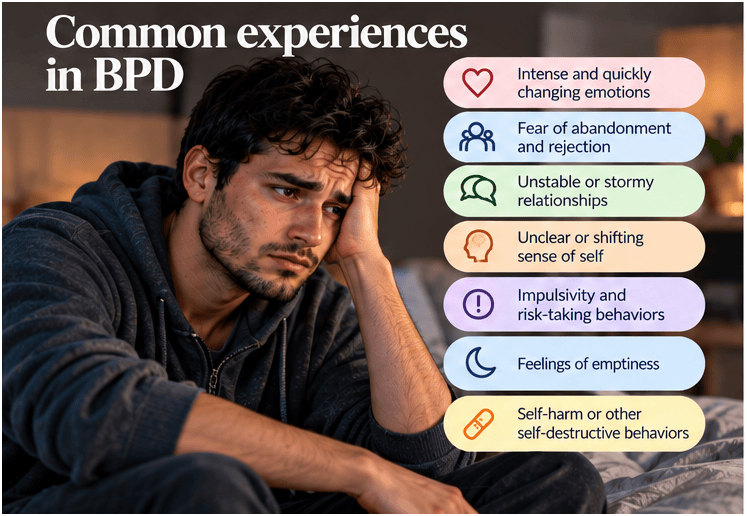
You may experience emotions that seem to change incredibly quickly.
A disagreement with someone you care about might trigger overwhelming feelings of rejection.
You may desperately want closeness while simultaneously worrying that the people closest to you will eventually leave.
At other times, you might feel empty, uncertain about who you are or confused about what you really want.
These experiences can be exhausting.
They can also be misunderstood.
BPD isn’t simply “being emotional” or having difficult relationships. It is a recognized mental-health condition that requires appropriate professional assessment.
The encouraging part is that BPD is treatable, and psychological therapy can help people develop skills for managing emotions, navigating relationships, reducing harmful behaviors and building a more stable sense of self.
For some people, online therapy provides an accessible way to begin getting professional support.
Learn more about Online-Therapy.com’s BPD program:
https://www.online-therapy.com/bpd
What Is Borderline Personality Disorder?
Borderline personality disorder is a mental-health condition associated with ongoing difficulties in areas such as emotional regulation, relationships, identity and behavior.
The exact experience varies considerably from person to person.
One individual may struggle primarily with intense emotions and relationships.
Another may experience significant impulsivity.
Someone else might describe a persistent feeling of emptiness or uncertainty about their identity.
This is one reason BPD shouldn’t be diagnosed from a short description or online article.
A qualified mental-health professional needs to consider the broader pattern, how long difficulties have been present and whether another condition could better explain some or all of the symptoms.
If you recognize yourself in parts of this article, that doesn’t automatically mean you have BPD.
It may, however, be a reason to consider professional assessment if these patterns are causing significant distress.
Understanding Emotional Intensity in BPD
Imagine receiving a short message from someone you love:
“We need to talk later.”
One person might think:
“I wonder what they want to discuss.”
Someone struggling with intense fear of abandonment might immediately think:
“They’re leaving me.”
The emotional response can arrive extremely quickly.
Fear.
Panic.
Anger.
Sadness.
You might send multiple messages seeking reassurance.
Perhaps you become angry before the conversation has even happened.
Or you withdraw because you want to protect yourself from anticipated rejection.
Later, you discover the conversation wasn’t about ending the relationship at all.
But by then, the emotional reaction may already have created conflict.
Therapy can help create more space between an emotional trigger and the behavior that follows it.
Fear of Abandonment and Rejection
Fear of abandonment is commonly associated with BPD.
This doesn’t necessarily mean someone is constantly being abandoned.
Rather, situations that suggest possible rejection or separation can trigger intense emotional responses.
A partner doesn’t answer a message.
A friend cancels plans.
Someone appears distracted during a conversation.
A therapist goes on holiday.
A colleague doesn’t invite you somewhere.
Events like these may be interpreted as signs that a relationship is ending.
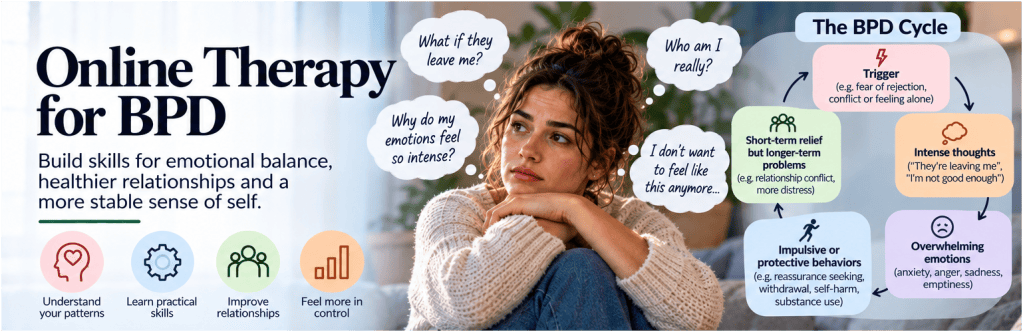
The fear can then influence behavior.
You might repeatedly seek reassurance.
Become angry.
Withdraw first.
Test the relationship.
Or make impulsive attempts to prevent the person from leaving.
Unfortunately, some of these behaviors can create additional relationship difficulties, reinforcing the original fear.
Therapy can help identify this cycle.
Why Relationships Can Feel So Intense
Relationships can be deeply meaningful to people with BPD.
But they may also become a major source of emotional distress.
Someone can feel extremely close to another person and then, following disappointment or conflict, experience a dramatic change in how they see that person.
This doesn’t necessarily mean the person is deliberately being inconsistent.
Strong emotional states can influence how situations and relationships are interpreted.
When you’re frightened of rejection, ambiguous behavior can look like evidence of abandonment.
When you’re angry, it can become difficult to remember positive aspects of the relationship.
Therapy can help you hold a more balanced view during intense emotional moments.
A person can disappoint you without being entirely bad.
A disagreement doesn’t automatically mean a relationship is ending.
Someone can need space while still caring about you.
These distinctions can become easier to recognize with practice.
BPD and Sense of Self
BPD can also involve instability in how someone sees themselves.
You may feel confident about your identity and goals one day and completely uncertain the next.
Your plans, values, ambitions or sense of who you are may shift.
You might depend heavily on relationships for a sense of identity.
When a relationship changes, you can feel as though you’ve lost part of yourself.
Therapeutic work can involve exploring your own values, needs, boundaries and goals.
The objective isn’t for a therapist to tell you who you are.
It’s to help you develop a more stable understanding of yourself that isn’t entirely dependent on other people’s approval or presence.
Why Impulsivity Can Become a Problem
Strong emotions create pressure for immediate relief.
When emotional pain feels overwhelming, doing something quickly can seem easier than tolerating the feeling.
That can contribute to impulsive behavior.
Depending on the person, this might involve problematic spending, substance use, unsafe behavior, angry communication or other actions that create longer-term consequences.
The immediate behavior may provide temporary distraction or relief.
But afterward, there can be regret, shame, financial difficulties, relationship problems or health consequences.
A major goal of therapy can be learning how to survive intense emotional moments without automatically acting on every urge.
BPD and Self-Harm
Some people with BPD engage in self-harm or experience suicidal thoughts, although these experiences aren’t present in everyone with BPD.
Self-harm can occur for different reasons, including attempts to cope with overwhelming emotional distress.
It should always be taken seriously.
If you’re harming yourself, experiencing suicidal thoughts or concerned that you may not be able to keep yourself safe, tell an appropriate healthcare or mental-health professional.
Routine online therapy may not provide the level of support required during an immediate crisis.
If you’re in immediate danger or believe you may act on suicidal or self-harm thoughts, contact your local emergency or crisis service or go to an appropriate emergency department.
You deserve support that matches the urgency of the situation.
When Should You Consider Therapy for BPD?
You don’t have to wait until your relationships or everyday life have completely broken down.
Professional support may be appropriate whenever persistent emotional or behavioral patterns are causing significant distress.
Several signs may indicate that it’s time to talk with a professional.
1. Your Emotions Frequently Feel Overwhelming
Everyone experiences intense emotions occasionally.
But perhaps your emotions repeatedly feel impossible to manage.
A relatively small event can produce hours of distress.
You may know intellectually that your reaction is unusually strong while still feeling unable to reduce it.
Therapy can help you develop skills for identifying emotions, understanding triggers and responding more effectively.
2. Fear of Rejection Is Controlling Your Relationships
Perhaps you constantly look for signs that someone is leaving.
You repeatedly ask whether your partner still loves you.
A delayed message feels unbearable.
You become distressed when plans change.
If fear of rejection repeatedly creates conflict or dominates your relationships, therapy may help you understand the pattern and develop alternative responses.
3. Relationships Repeatedly Move Between Extremes
You may experience relationships as intensely close one moment and deeply painful the next.
Minor disappointments can become major conflicts.
Afterward, you may regret things you said or did.
If the same cycle occurs repeatedly across different relationships, exploring it with a therapist can be useful.
4. You Act Impulsively When Upset
One useful question is:
“What do I do when my emotions become intense?”
If the answer frequently involves actions that create harm or serious consequences, professional support is important.
Therapy can help you learn to recognize the moment between an emotional trigger and an impulsive response.
That space may initially feel very small.
With practice, it can become larger.
5. You Frequently Feel Empty or Unsure Who You Are
A persistent sense of emptiness can be difficult to explain to other people.
From the outside, your life may appear normal.
Internally, however, you may feel disconnected, unfulfilled or uncertain about yourself.
Therapy can provide a structured space for exploring these experiences rather than trying to escape them through impulsive behavior or unstable relationships.
How Can Therapy Help With BPD?
BPD treatment generally focuses on helping people understand and manage patterns involving emotions, thoughts, behaviors and relationships.
Different evidence-based therapies are used for BPD.
One particularly well-known treatment is Dialectical Behavior Therapy (DBT).
DBT was developed specifically for people experiencing significant emotional dysregulation and has become an established treatment for BPD.
Other structured psychological approaches may also be used depending on the individual.
Online-Therapy.com bases its broader therapeutic approach on Cognitive Behavioral Therapy (CBT) principles.
If you’re seeking treatment specifically for diagnosed BPD, it is reasonable to ask whether the therapist or service provides the type of BPD-focused treatment appropriate for your needs.
Learning Emotional Regulation
Emotional regulation doesn’t mean suppressing emotions.
The goal isn’t to stop feeling anger, sadness, fear or disappointment.
Those emotions contain information.
Instead, emotional regulation involves learning how to experience feelings without automatically being controlled by them.
Therapeutic work may help you recognize:
What triggered the emotion?
What interpretation did you make?
What physical sensations appeared?
What urge followed?
What action are you considering?
What could happen if you act immediately?
Creating this awareness can make it easier to choose a response rather than simply reacting.
Learning to Tolerate Distress
Some emotional experiences cannot be solved immediately.
A relationship conflict may take time to resolve.
You may not know whether someone is upset with you.
You might have to wait for an answer.
That uncertainty can feel extremely uncomfortable.
Distress-tolerance skills focus on getting through difficult moments without making the situation worse.
This can be particularly important when your immediate impulse is to send an angry message, use substances, engage in self-harm or take another action that may have serious consequences.
The objective is not to pretend the distress isn’t real.
It’s to learn:
“I can experience this emotion without immediately acting on it.”
Improving Relationship Skills
Healthy relationships require a balance between closeness and independence.
Therapy can help you develop skills for communicating what you need without attacking, withdrawing or assuming that the other person already knows.
You may work on expressing boundaries.
Listening during disagreements.
Asking directly for reassurance rather than testing a relationship.
Recognizing when an emotional interpretation may not match the available evidence.
Learning that conflict doesn’t automatically mean abandonment.
These skills can improve relationships while also increasing your confidence in handling disagreements.
Examining All-or-Nothing Thinking
Intense emotions can sometimes encourage extreme interpretations.
Someone is wonderful or terrible.
A relationship is perfect or completely broken.
You succeeded or you’re a failure.
CBT-based work can help you notice these extremes.
Suppose a friend cancels dinner.
An automatic interpretation might be:
“They don’t care about me.”
A more balanced interpretation could be:
“I’m disappointed that they cancelled, and I don’t yet know why. One cancelled plan doesn’t tell me everything about the friendship.”
The goal isn’t to invalidate disappointment.
It’s to prevent one event from automatically becoming evidence for a much larger conclusion.
Why Online Therapy May Be Helpful
Online therapy can reduce some of the practical barriers associated with attending therapy.
You don’t need to travel to an office.
You can participate from an appropriate private environment.
That can make regular engagement easier for some people.
Digital therapy can also support structured exercises and reflection between sessions.
When a difficult interaction occurs, you may be able to record what happened, what you thought, how you felt and what you did.
That information can then become useful therapeutic material.
Online-Therapy.com provides online therapeutic programs with professional support and a structured CBT-based approach, depending on the applicable program and plan.
Explore Online-Therapy.com’s BPD program:
Online Therapy and Continuity
Consistency can be particularly important when working with long-standing emotional and relationship patterns.
Change rarely comes from understanding something once.
Skills need practice.
You may handle one difficult situation successfully and struggle with the next.
That doesn’t necessarily mean therapy isn’t working.
Therapeutic progress often involves repetition:
Recognize the trigger.
Notice the emotion.
Identify the thought.
Pause before acting.
Use a skill.
Reflect on what happened.
Try again.
Over time, a response that initially required enormous effort can become more familiar.
What Therapy Doesn’t Do
Therapy shouldn’t erase your personality.
It isn’t designed to turn an emotionally sensitive person into someone who doesn’t care.
Nor should therapy teach you that every relationship problem is your fault.
The objective is to understand patterns that are causing distress and develop greater choice over how you respond.
You can care deeply about people without every disagreement becoming a crisis.
You can experience anger without acting destructively.
You can fear rejection without treating every uncertain situation as proof that abandonment is happening.
You can have intense emotions while learning to manage them more safely.
When Online Therapy May Not Be Enough
This is especially important with BPD because symptom severity varies substantially.
Some people can use routine outpatient or online therapy effectively.
Others require more intensive or specialized services.
If you’re experiencing repeated serious self-harm, active suicidal intent, severe substance misuse, inability to keep yourself safe or another acute psychiatric crisis, routine online therapy alone may not be sufficient.
You may need urgent assessment, crisis services, psychiatric support or a more intensive treatment program.
Likewise, if you’re specifically looking for comprehensive DBT, check what the service actually provides. Full DBT can involve individual therapy, structured skills training and other components that may not be included in every online therapy program.
Choosing the appropriate level of care is more important than choosing therapy simply because it’s convenient.
BPD Is Not a Character Flaw
The word “personality” can unfortunately lead to stigma.
It can make the condition sound as though the problem is simply who someone is.
That’s not a helpful way to understand BPD.
BPD involves patterns of emotional, behavioral, interpersonal and identity-related difficulties that can be treated.
A diagnosis should provide a framework for understanding difficulties and selecting treatment—not a judgment about someone’s character.
People with BPD are individuals.
They have different strengths, personalities, relationships, goals and experiences.
No diagnosis describes an entire person.
Progress Can Be Gradual
Therapeutic progress may not mean never feeling intense emotions again.
Instead, you may notice changes such as:
You recognize an abandonment fear before sending repeated messages.
You pause during an argument.
You communicate what you need more directly.
You recover more quickly after disappointment.
You become less impulsive when distressed.
You feel more confident setting boundaries.
You develop a more stable sense of your own identity.
You use safer strategies during emotional crises.
Those changes can significantly affect everyday life.

Taking the First Step
If you recognize patterns involving unstable relationships, intense emotions, impulsivity, fear of abandonment or uncertainty about your identity, you don’t need to decide for yourself whether you have BPD.
You can begin with an assessment.
Describe what you’ve been experiencing.
Explain what happens during conflicts.
Talk about the behaviors you’re concerned about.
A qualified professional can consider the broader picture and help determine what type of support may be appropriate.
If BPD is diagnosed, appropriate psychological treatment can help you understand your patterns and develop skills for managing them.
Online therapy may provide an accessible way to begin or continue that work when remote treatment is clinically appropriate.
Explore Online Therapy for BPD
Living with intense emotions doesn’t mean those emotions have to control every decision you make.
With appropriate professional support, you can work on understanding triggers, regulating emotions, managing impulses, communicating more effectively and developing healthier relationship patterns.
Learn more about Online-Therapy.com’s BPD program:
Change doesn’t necessarily mean becoming a different person.
It can mean gaining more choice over what you do when powerful emotions appear.
And that can be an important step toward creating a more stable and fulfilling everyday life.
Important Safety Information
This article is for general educational purposes and isn’t a diagnosis or individualized treatment plan. BPD should be assessed by an appropriately qualified mental-health professional, and symptoms can overlap with other conditions.
If you’re currently self-harming, experiencing suicidal thoughts or worried about your ability to stay safe, seek professional support promptly. If you believe you may act on suicidal or self-harm thoughts, are in immediate danger or are experiencing another acute mental-health emergency, contact your local emergency or crisis service or attend an appropriate emergency department.
Routine online therapy isn’t a substitute for emergency or crisis care.


Leave a Reply