



Why It Can Help and How It Works
Do you feel sad, empty or hopeless more often than you used to?
Perhaps you’re having trouble sleeping, struggling to find enough energy to get through the day or discovering that activities you once enjoyed no longer seem interesting.
Everyone experiences periods of sadness. Mood changes can be natural responses to disappointment, stress, loss and the ordinary ups and downs of life.
Depression, however, can be different.
When feelings of emptiness, hopelessness or worthlessness persist, or when changes in mood, motivation, sleep and energy begin interfering with everyday life, it may be time to consider professional support.
Depression can affect how you think, feel and behave. It can influence relationships, work, sleep, appetite, concentration and even your perception of yourself and the future.
One option for accessing support is online therapy for depression.
Instead of traveling to a therapist’s office, online therapy allows you to access professional mental-health support remotely. For someone already struggling with motivation, energy or leaving the house, that accessibility can be particularly valuable.
Online-Therapy.com offers an online program based around Cognitive Behavioral Therapy (CBT), an established psychological approach that explores connections between thoughts, emotions and behaviors.
Explore Online-Therapy.com’s Depression Program:
What Is Depression?
Depression isn’t simply feeling sad.
Sadness is an emotion that everyone experiences.
You may feel sad because a relationship ended, something went wrong at work or you experienced a disappointment. In many situations, the feeling gradually changes as circumstances change or as you adapt.
Depression can involve a broader and more persistent collection of symptoms.
Someone experiencing depression might feel sad, empty, discouraged, irritable or emotionally numb.
Another important feature can be a loss of interest or pleasure in activities that previously felt enjoyable.
Perhaps you once loved meeting friends, exercising, cooking, playing music or watching your favorite television programs.
Now these activities feel like work.
Or you simply don’t feel anything when you do them.
Depression can also involve changes in sleep, appetite, energy, concentration, movement and self-esteem.
Because symptoms vary, depression doesn’t necessarily look the same from one person to another.
Why Can Depression Be Difficult to Recognize?
Depression doesn’t always arrive dramatically.
Sometimes it develops gradually.
You stop exercising because you’re tired.
You turn down a social invitation because you don’t feel like going.
You stop cooking and start eating whatever requires the least effort.
You leave messages unanswered.
Work becomes harder.
Weekends are increasingly spent in bed or on the sofa.
Each individual change might seem relatively minor.
But over weeks or months, you may realize that your life has become much smaller.
This gradual development is one reason people don’t always recognize depression immediately.
They may tell themselves:
“I’m just tired.”
“Work has been difficult.”
“I need to get myself together.”
Sometimes people blame themselves for symptoms that may actually deserve professional attention.
Why Consider Online Therapy for Depression?
Depression can create a frustrating contradiction.
The things that might help—talking to someone, making an appointment, leaving home or engaging in meaningful activities—can feel particularly difficult when your energy and motivation are low.
Online therapy can reduce some of those practical barriers.
You don’t need to commute to an office.
You can access support from an appropriate private location.
For some people, communicating remotely can also make the initial step into therapy feel less intimidating.
Convenience isn’t the same as effectiveness, of course.
The more important question is:
What does therapy actually help you do differently?
To understand that, it helps to look at the cycles that can occur during depression.
The Depression Cycle
Depression can involve relationships between thoughts, feelings and behaviors.
Imagine you’ve been feeling low.
A friend invites you to dinner.
Your automatic thought is:
“I won’t be good company. There’s no point going.”
You decline.
In the short term, staying home requires less effort.
But you also lose an opportunity for social connection and potentially enjoyable activity.
You spend the evening alone.
Your mood remains low.
Then you think:
“I don’t do anything anymore.”
That thought makes you feel worse.
The next invitation becomes even easier to decline.
A cycle can develop:
Low mood → withdrawal → fewer rewarding experiences → more negative thoughts → lower mood
One aim of therapy can be to identify cycles like these and gradually change them.
How Can CBT Help With Depression?
Cognitive Behavioral Therapy examines relationships between your thoughts, emotions and behaviors.
It doesn’t simply tell you to “think positively.”
Nor does it suggest that depression exists only because you’re thinking incorrectly.
Instead, CBT can help you identify patterns that may be contributing to ongoing distress and develop more balanced ways of responding.
Imagine making a mistake at work.
One interpretation might be:
“I made an error. I’ll correct it.”
A depression-related pattern of thinking might turn the same event into:
“I can’t do anything right. I’m useless.”
The mistake is real.
The conclusion that one mistake proves you’re useless is an interpretation.
Therapy can help you learn to notice that distinction.
Identifying Automatic Negative Thoughts
Depression can influence the way you interpret everyday experiences.
You might receive positive feedback from five people and criticism from one.
Which comment stays in your mind all evening?
If you’re experiencing depression, you may find yourself focusing almost exclusively on the criticism.
Negative automatic thoughts can include:
“I’m a failure.”
“Nothing will ever change.”
“Nobody wants me around.”
“I’m letting everyone down.”
“There’s no point trying.”
When repeated frequently, these thoughts can begin to feel like objective facts.
CBT can help you slow the process down.
What actually happened?
What thought appeared?
What emotion followed?
What evidence supports the thought?
Is there information you’re overlooking?
Could there be another interpretation?
This isn’t about pretending everything is wonderful.
It’s about trying to see situations more completely.
Depression Can Change How You See Yourself
Depression can be particularly damaging to self-image.
A temporary problem becomes evidence of a permanent personal flaw.
You make a mistake and think:
“I’m incompetent.”
Someone doesn’t respond to a message and you think:
“Nobody cares about me.”
You struggle to complete a task and conclude:
“I’m lazy.”
The language becomes global.
Instead of recognizing something you did, you turn it into a statement about who you are.
Therapy can help identify these patterns and develop a more proportionate view.
A difficult period doesn’t define your entire identity.
Why Behavior Is So Important
When people hear “Cognitive Behavioral Therapy,” they sometimes focus exclusively on the thinking part.
But behavior is equally important.
Depression often reduces motivation.
When motivation falls, activity falls.
You may stop exercising.
Stop seeing friends.
Stop pursuing hobbies.
Household tasks accumulate.
You fall behind at work.
Each change can create additional stress and reduce opportunities for enjoyment or achievement.
Waiting until you feel motivated before doing anything can therefore become a trap.
Sometimes behavior needs to begin changing before motivation fully returns.
Behavioral Activation and Depression
A behavioral approach to depression can involve gradually reintroducing meaningful activities.
This doesn’t mean suddenly creating an enormous schedule.
If getting out of bed currently feels difficult, being told to completely transform your life tomorrow is unlikely to be useful.
Instead, therapeutic work may involve manageable steps.
Take a shower.
Walk outside for a short period.
Prepare a meal.
Reply to one message.
Complete one household task.
Meet someone you trust.
Return gradually to an activity that previously mattered to you.
The purpose isn’t to pretend you’re not depressed.
It’s to create opportunities for achievement, connection and enjoyment that withdrawal may have removed.
Why Small Steps Matter
Depression can encourage all-or-nothing thinking.
You may believe that unless you can accomplish something completely, there’s no point beginning.
If you can’t clean the entire house, why clean one room?
If you can’t exercise for an hour, why walk for ten minutes?
If you can’t solve every problem at work, why start one task?
Therapy can help challenge this pattern.
Ten minutes of activity isn’t the same as doing nothing.
One completed task isn’t everything, but it is still one completed task.
When energy is limited, smaller actions can be a realistic way of rebuilding momentum.
Online Therapy Can Provide Structure
One difficulty with depression is that days can begin blending together.
Sleep patterns change.
Routines disappear.
Tasks get postponed.
Without structure, it can become harder to recognize progress or identify what affects your mood.
Structured online therapy can help bring attention back to patterns.
Online-Therapy.com’s approach is based around CBT and can include structured therapeutic material and professional therapist support, depending on the applicable program and service.
You may work on identifying thoughts, reflecting on behaviors and applying therapeutic ideas to your daily life.
The online format also means therapeutic work doesn’t necessarily have to be confined to a therapist’s physical office.
Therapy Can Help With Hopeless Thinking
One of the most painful aspects of depression can be the feeling that things will never improve.
Depression can make the present feel permanent.
You may think:
“I’ve always felt like this.”
“Nothing can help.”
“There’s no future for me.”
These thoughts deserve particular attention.
Therapy can help you examine whether your current emotional state is influencing predictions about the future.
Nobody can guarantee that every problem will disappear.
But feeling hopeless isn’t the same thing as having objective evidence that improvement is impossible.
Creating that distinction can matter.
Online Therapy and Sleep Problems
Sleep and depression can be closely connected.
Some people with depression struggle to fall asleep or wake repeatedly.
Others sleep much longer than usual but still feel exhausted.
Poor sleep can make concentration and emotional regulation more difficult, potentially adding another layer to the problem.
Therapy may help explore habits, thoughts or emotional factors affecting sleep.
However, significant or persistent sleep problems can also have other causes, so medical assessment may sometimes be appropriate.
Depression and Low Energy
Depression can make simple tasks feel physically demanding.
Taking a shower may feel exhausting.
Preparing food feels complicated.
Going to work requires enormous effort.
Other people may not understand because they can’t necessarily see what’s happening internally.
This is one reason depression shouldn’t simply be interpreted as laziness or lack of discipline.
Therapeutic support can help you work with your current level of functioning while gradually identifying realistic opportunities for change.
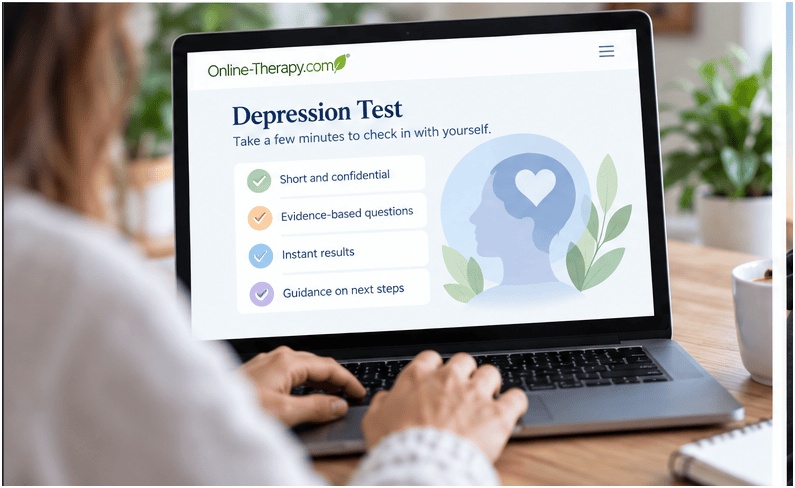
When Should You Consider Online Therapy for Depression?
You don’t have to wait until depression becomes severe before seeking support.
Consider talking with a professional if persistent changes in mood, motivation or functioning are concerning you.
Signs worth paying attention to can include ongoing sadness or emptiness, loss of interest in activities, persistent hopelessness, changes in sleep or appetite, low energy, difficulty concentrating, social withdrawal or feelings of worthlessness.
The impact on everyday life is particularly important.
Are you struggling to work?
Have you stopped seeing people?
Are ordinary responsibilities becoming increasingly difficult?
Do you no longer enjoy things that previously mattered to you?
If so, professional assessment may be useful.
You Don’t Need to Be Certain You Have Depression
You may be thinking:
“What if I’m not depressed enough for therapy?”
You don’t need to diagnose yourself first.
That’s one purpose of professional assessment.
You can describe what you’re experiencing and how long it has been happening.
A qualified professional can then help determine what kind of support may be appropriate.
Several medical and psychological conditions can produce symptoms that overlap with depression.
Seeking an assessment is therefore more useful than trying to establish a diagnosis entirely by yourself.
When Medical Assessment Is Important
Mood, energy and sleep can also be affected by physical health conditions, medications, hormonal changes, substance use and other factors.
If symptoms are new, unexplained, persistent or accompanied by significant physical changes, speaking with a healthcare professional may be appropriate.
Therapy and medical care aren’t necessarily alternatives.
Some people benefit from psychological treatment alone, while others may receive therapy alongside medication or other forms of care.
Treatment decisions should be individualized with appropriately qualified professionals.
Why Choose Online Therapy?
Traditional face-to-face therapy can be valuable, but it isn’t always convenient or accessible.
Online therapy may appeal to people who have difficulty traveling, live far from suitable services, have demanding schedules or simply prefer communicating from home.
For someone experiencing depression, removing the journey to an appointment can make starting support more manageable.
You can access therapy from a familiar environment.
You may also be able to work on structured exercises between interactions with your therapist.
That ongoing engagement fits naturally with CBT, where practicing skills outside therapy is an important part of the process.
Learn more about Online-Therapy.com’s depression program:
https://www.online-therapy.com/depression
What Progress Can Look Like
Recovery doesn’t necessarily mean waking up one morning and suddenly feeling completely different.
Progress can be gradual.
You notice a negative thought without automatically believing it.
You get out of bed a little earlier.
You reply to a friend.
You return to an activity you’ve been avoiding.
You complete a task that seemed impossible last week.
You experience a difficult day without deciding that all your progress has disappeared.
Over time, these changes can accumulate.
Therapy can help you recognize progress that might otherwise be easy to dismiss.
Online Therapy Isn’t About Being Positive All the Time
One of the most important misconceptions about therapy is that the objective is constant happiness.
It isn’t.
Sadness, disappointment, frustration and grief are normal human emotions.
CBT doesn’t require replacing every difficult thought with a cheerful one.
A more realistic objective is psychological flexibility.
Can you recognize when your mind is making an extreme conclusion?
Can you distinguish a feeling from a fact?
Can you take constructive action even when motivation is low?
Can you respond to setbacks without automatically concluding that everything is hopeless?
Those are skills that can remain useful long after therapy ends.
When Online Therapy May Not Be Enough
Online therapy isn’t appropriate for every circumstance.
Severe depression can require more intensive treatment, medical assessment or psychiatric care.
If symptoms are rapidly worsening, you’re unable to care for yourself safely, or you’re experiencing other severe mental-health symptoms, seek appropriate professional assessment rather than relying solely on a routine online program.
If you’re thinking about suicide or harming yourself, treat that as urgent.
Contact your local emergency service or crisis service, or go to an appropriate emergency department. If possible, tell someone you trust what you’re experiencing and avoid remaining alone with an immediate risk.
Taking the First Step
Depression can tell you that nothing will change.
It can tell you that getting help is pointless.
It can tell you to wait until you have more energy, feel more motivated or somehow solve the problem yourself.
But you don’t need to have everything figured out before speaking with someone.
You can start with a simple description:
“I haven’t felt like myself recently.”
From there, you can begin exploring what’s happening.
Online therapy offers one way to take that first step without having to travel to a therapist’s office.
Through CBT-based therapy, you can learn to recognize relationships between thoughts, emotions and behaviors, challenge unhelpful patterns and gradually reintroduce activities that give life structure, connection and meaning.

Explore Online Therapy for Depression
If persistent sadness, hopelessness, loss of interest, low energy or other symptoms are interfering with your life, consider seeking professional support.
Online-Therapy.com – Online Therapy for Depression
Depression can make change feel impossible.
Therapy doesn’t promise that every difficult feeling will disappear. What it can offer is a structured process for understanding what’s happening, developing new skills and working toward meaningful change one step at a time.
Important Information
This article provides general educational information and isn’t a diagnosis, medical advice or an individualized treatment plan. Depression and similar symptoms can have different causes, and an appropriately qualified healthcare or mental-health professional can assess your individual circumstances.
Online therapy isn’t a substitute for emergency or crisis care. If you’re at immediate risk of harming yourself or someone else, or are experiencing a severe mental-health crisis, seek urgent assistance through your local emergency or crisis services.


Leave a Reply