


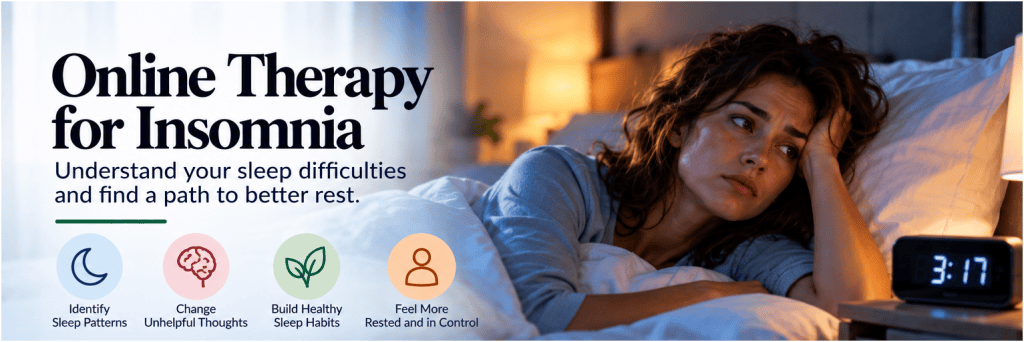
Why Sleep Problems Persist and When to Seek Support
You go to bed feeling exhausted.
You turn off the light, close your eyes and expect sleep to arrive.
Twenty minutes pass.
Then forty.
You look at the clock.
Now you’re thinking about how tired you’ll be tomorrow.
You calculate how many hours of sleep you could still get if you fall asleep immediately.
But the harder you try to sleep, the more awake you seem to become.
Or perhaps falling asleep isn’t the problem.
Maybe you fall asleep easily but wake repeatedly throughout the night. You might wake at 2:00 a.m., fall asleep again, wake at 3:30 a.m. and spend another hour staring at the ceiling.
Some people wake much earlier than they intended and can’t return to sleep.
When these problems happen occasionally, they’re usually frustrating but temporary.
Stress at work, relationship difficulties, travel, illness or major life changes can all interfere with sleep.
But when poor sleep becomes persistent, the consequences can spread into your waking life.
You may become irritable, anxious or emotionally exhausted. Concentrating at work can become harder. Your motivation may decrease, and you may begin organizing your life around how tired you expect to feel.
Eventually, you can become anxious about sleep itself.
This is where psychological treatment may help.
Online therapy for insomnia can provide a convenient way to explore the thoughts, habits and behaviors that may be contributing to ongoing sleep difficulties.
Learn more about Online-Therapy.com’s Insomnia Program:
What Is Insomnia?
Insomnia generally involves persistent difficulty falling asleep, staying asleep or obtaining sleep that feels sufficiently restorative despite having an adequate opportunity to sleep.
Different people experience insomnia differently.
One person may lie awake for hours before falling asleep.
Another falls asleep quickly but wakes repeatedly.
Someone else may consistently wake very early in the morning.
The important point isn’t simply the number of hours spent in bed.
It’s whether sleep difficulties are persistent and are affecting how you function or feel during the day.
Occasional poor sleep is common.
Persistent insomnia is different.
Why Do We Sometimes Struggle to Sleep?
Sleep seems as though it should be automatic.
And normally, it is.
You don’t consciously instruct your brain to fall asleep in the same way you decide to stand up or open a door.
The difficulty is that because sleep happens automatically, trying extremely hard to make it happen can sometimes become counterproductive.
Imagine lying in bed thinking:
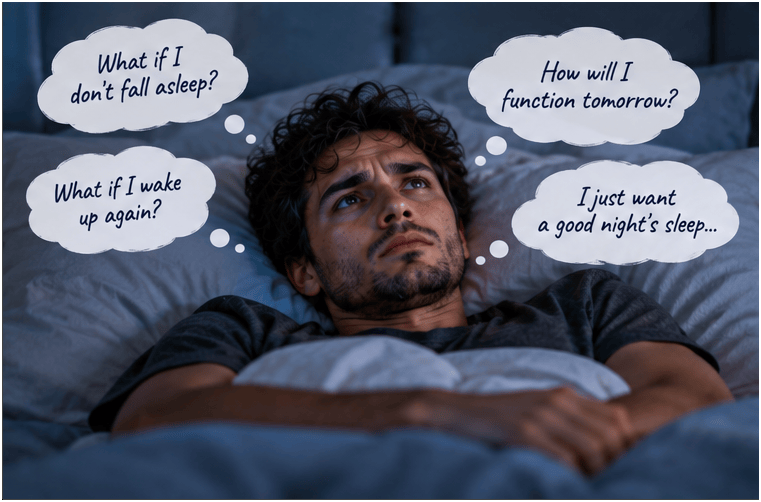
“I have to fall asleep now.”
Then:
“Why am I still awake?”
You check the time.
“If I fall asleep now, I can still get six hours.”
Twenty minutes later:
“Now I’ll only get five and a half.”
Your frustration increases.
Your body becomes more alert.
Instead of associating bed with relaxation and sleep, you begin associating it with worry, effort and frustration.
Over time, this can become a self-reinforcing cycle.
The Insomnia Cycle
Many people initially develop sleep difficulties during a stressful period.
Perhaps work becomes demanding.
You experience relationship problems.
You become worried about money.
For a few nights, you sleep poorly.
That’s understandable.
But then something changes.
You begin worrying about the sleep problem itself.
Step 1: You have a poor night’s sleep.
You feel exhausted the next day.
Step 2: You become worried about tonight.
“What if I can’t sleep again?”
Step 3: You try harder to sleep.
You go to bed unusually early or spend more time in bed.
Step 4: You monitor your sleep.
You check the clock and calculate how much sleep remains.
Step 5: Anxiety increases.
Your mind becomes more alert precisely when you want it to become less alert.
Step 6: Sleep becomes more difficult.
The next morning, your belief that you “can’t sleep” becomes even stronger.
Breaking patterns like this is one of the areas psychological approaches to insomnia can address.
Why Is Sleep So Important?
Sleep supports many aspects of physical and psychological functioning.
After a poor night’s sleep, you may notice changes almost immediately.
You might feel irritable.
Concentration becomes difficult.
Simple decisions require more effort.
You may struggle to remember information or remain focused on tasks.
Motivation can decrease.
When sleep problems continue, the impact can become increasingly noticeable in work, relationships and everyday activities.
Persistent sleep difficulties can also occur alongside mental-health concerns such as anxiety or depression.
That doesn’t mean insomnia automatically causes a particular mental-health condition, or that every sleep problem has a psychological cause.
It does mean that persistent sleep difficulties deserve attention.
When Should You Consider Online Therapy for Insomnia?
You don’t necessarily need professional therapy because you’ve had two or three bad nights.
However, there are situations in which seeking professional advice becomes more appropriate.
1. Sleep Problems Keep Returning
Perhaps you’ve tried going to bed earlier.
You’ve bought a new pillow.
You’ve changed your evening routine.
Things improve temporarily, but the problem repeatedly returns.
When insomnia becomes an ongoing pattern rather than an occasional response to a stressful week, it may be worth looking at the broader factors maintaining it.
2. You’re Becoming Anxious About Bedtime
Bedtime should ideally signal that the day is ending.
With persistent insomnia, it can begin to feel like a test.
As evening approaches, you start worrying.
“Will I sleep tonight?”
You become hyperaware of whether you’re tired enough.
You monitor every yawn.
By the time you get into bed, your mind is already alert.
If bedtime itself has become associated with anxiety, psychological treatment may help you change that relationship.
3. You Spend Long Periods Awake in Bed
One common pattern involves spending more and more time in bed in an attempt to obtain more sleep.
It seems logical.
If eight hours in bed isn’t producing enough sleep, perhaps ten hours will.
But spending long periods awake in bed can strengthen the association between the bed and wakefulness.
You may begin reading, scrolling through your phone, worrying, watching television or thinking about tomorrow while lying there.
Therapeutic approaches to insomnia can help examine these patterns and rebuild healthier associations between bed and sleep.
4. You Constantly Check the Clock
It’s 1:12 a.m.
Then 1:27.
Then 1:51.
Each time you look at the clock, you perform another calculation.
“If I fall asleep right now…”
Clock-watching can transform the night into a countdown.
Instead of helping you sleep, it may increase pressure and frustration.
Therapy can help identify behaviors like these that seem helpful but may actually be maintaining sleep-related anxiety.
5. Poor Sleep Is Affecting Your Day
One of the most important questions isn’t simply:
“How many hours did I sleep?”
It’s:
“How are my sleep difficulties affecting my life?”
Perhaps you’re struggling to concentrate at work.
You’re becoming impatient with your family.
You don’t have the energy to exercise or socialize.
You’re worried about driving because you’re extremely tired.
When sleep difficulties significantly interfere with daytime functioning, professional assessment becomes more important.
If you’re dangerously sleepy, particularly while driving or operating machinery, take the risk seriously and seek appropriate medical advice.
6. You’re Organizing Your Entire Life Around Sleep
You turn down evening invitations because you’re afraid they will disrupt your routine.
You cancel morning activities because you expect to be exhausted.
You spend weekends trying to “catch up.”
You think about sleep throughout the day.
At this stage, insomnia isn’t only affecting the night.
It’s beginning to control daytime decisions too.
That can be an important sign that additional support is worth considering.
How Can Online Therapy Help With Insomnia?
One established psychological treatment for persistent insomnia is Cognitive Behavioral Therapy for Insomnia, often called CBT-I.
CBT-I addresses thoughts and behaviors that can contribute to ongoing sleep difficulties.
Rather than simply telling you to relax or go to bed earlier, it examines the patterns surrounding your sleep.
These may include sleep-related anxiety, excessive time in bed, irregular routines, clock-watching, unhelpful beliefs about sleep and habits that have developed in response to insomnia.
The specific treatment should be individualized, particularly when other medical or psychological conditions are present.
Challenging Unhelpful Thoughts About Sleep
Insomnia can generate powerful predictions.
“If I don’t get eight hours, tomorrow will be a disaster.”
“I’ll never sleep normally again.”
“I have to fall asleep within the next ten minutes.”
“I won’t be able to cope tomorrow.”
These thoughts can create additional pressure.
CBT-based approaches can help you examine them more carefully.
Maybe tomorrow will be more difficult after a poor night’s sleep.
But is it guaranteed to be a complete disaster?
Have you managed tired days before?
Does demanding sleep from yourself actually make sleep easier?
The goal isn’t to pretend that sleep doesn’t matter.
It’s to reduce catastrophic thinking that may be increasing arousal when you need to wind down.
Rebuilding the Connection Between Bed and Sleep
For someone without insomnia, getting into bed can automatically produce a sense of sleepiness.
For someone who has spent months awake in bed, the opposite may happen.
Bed becomes associated with thinking.
Worrying.
Checking the clock.
Scrolling.
Frustration.
Trying to sleep.
A structured behavioral approach may help rebuild the association between bed and sleep.
Some CBT-I programs use techniques involving the timing of bed and wake periods and reducing prolonged wakefulness in bed.
These strategies should be used appropriately and may require professional guidance, particularly if you have other health conditions or circumstances that affect sleep.
Sleep Hygiene: Helpful, but Not Always the Whole Answer
You’ve probably heard common sleep advice.
Keep a consistent schedule.
Limit caffeine later in the day.
Create a comfortable sleeping environment.
Reduce stimulating activities near bedtime.
These habits can certainly be useful.
But someone with chronic insomnia may already know them.
You can have a dark bedroom, expensive mattress and perfect evening routine and still lie awake worrying about whether you’re going to sleep.
That’s why treatment for persistent insomnia often needs to go beyond basic sleep hygiene.
It may need to address the thoughts, behaviors and learned associations surrounding sleep.
Why Consider Online Therapy for Insomnia?
One advantage of online therapy is convenience.
When you’re already exhausted, traveling to appointments may feel like another burden.
Online therapy allows you to access support from an appropriate private location.
It can also fit naturally with structured exercises.
You may be asked to monitor sleep patterns, identify thoughts or complete therapeutic worksheets between sessions.
Because insomnia occurs in your everyday environment, working on strategies at home can make it easier to observe patterns as they happen.
Online-Therapy.com provides a structured online therapy platform based around CBT principles.
Depending on the applicable program and plan, this can involve therapist support alongside digital therapeutic resources.
Explore Online-Therapy.com’s Insomnia Program:
Stress, Anxiety and Insomnia
Stress and sleep can influence each other.
You’re stressed, so you sleep poorly.
Then you’re tired, so everyday challenges become more difficult.
That increases stress.
You worry about sleeping.
Now you sleep even less.
Anxiety can create a similar cycle.
At night, when external distractions disappear, worries can suddenly become louder.
You replay conversations.
Think about tomorrow.
Imagine possible problems.
Online therapy can provide space to address not only sleep-specific behaviors but also emotional factors that may be contributing to nighttime arousal.
What About Depression and Sleep?
Changes in sleep can occur alongside depression and other mental-health conditions.
Some people experiencing depression have difficulty sleeping.
Others sleep much more than usual.
If sleep problems are accompanied by persistent sadness, loss of interest, hopelessness or significant changes in everyday functioning, consider discussing the broader pattern with a mental-health or healthcare professional.
Treating insomnia in isolation may not address everything that’s happening.
A proper assessment can help identify the most appropriate approach.
When Should You Talk to a Doctor?
Not all insomnia is primarily psychological.
Sleep difficulties can be influenced by medications, pain, hormonal changes, medical conditions, substance use and other sleep disorders.
For example, loud snoring, repeated breathing interruptions during sleep, waking while choking or gasping, or severe daytime sleepiness may require assessment for sleep-related breathing disorders.
Uncomfortable sensations or urges to move the legs can also warrant medical discussion.
Persistent sleep problems should therefore not automatically be assumed to be caused by stress or anxiety.
A healthcare professional can help assess possible underlying causes.
Be Careful With Sleeping Medication and Other Substances
When you’re desperate to sleep, it’s understandable to want something that works immediately.
Some medications can have an appropriate role in insomnia treatment when prescribed and monitored by a qualified healthcare professional.
However, medication decisions should be discussed with your doctor or prescriber.
Don’t stop prescribed sleep or psychiatric medication suddenly without medical advice.
Likewise, using alcohol or other substances to make yourself sleep can create additional problems and may worsen sleep quality or introduce dependence and safety risks.
Psychological treatment offers a different approach by addressing patterns that can contribute to ongoing insomnia.
Progress May Not Mean Perfect Sleep Every Night
Even people without insomnia occasionally have bad nights.
An important treatment goal isn’t necessarily achieving perfect sleep every single night.
That expectation can itself create pressure.
Progress may instead mean:
You spend less time worrying about sleep.
Bedtime feels less threatening.
You stop constantly checking the clock.
A poor night no longer ruins the following evening before it has even begun.
You become more confident that sleep can happen without forcing it.
And your daytime life becomes less dominated by what happened during the night.
That can represent meaningful improvement.
Taking the First Step Toward Better Sleep
When insomnia has continued for months, it’s easy to begin believing that you’re simply someone who “can’t sleep.”
But persistent sleep difficulties can involve patterns that are understandable and potentially changeable.
You may have started with stress.
Then came poor sleep.
Then worry about sleep.
Then attempts to compensate.
Eventually, the strategies you adopted to solve the problem may have become part of what keeps it going.
Online therapy can help you step outside that cycle and look at the complete picture.
What do you think about when you can’t sleep?
What behaviors have developed around bedtime?
How much time are you spending awake in bed?
Are you monitoring the clock?
Is anxiety contributing?
Are other mental-health concerns involved?
Could a medical or other sleep condition need assessment?
Understanding the answers can help identify the next step.

Explore Online Therapy for Insomnia
If difficulty falling asleep, repeated nighttime waking or persistent poor-quality sleep is affecting your mood, concentration or quality of life, consider exploring professional support.
Learn more about Online-Therapy.com’s online insomnia program:
Better sleep isn’t always about trying harder to sleep.
Sometimes it’s about understanding the thoughts and behaviors that have turned sleep into something you feel you have to force—and learning a different approach.
Important Information
This article is for general informational purposes and isn’t medical advice or a diagnosis. Persistent insomnia can have psychological, behavioral, medical, medication-related or other causes.
If sleep problems are ongoing, severe or significantly affecting your ability to function, consider discussing them with an appropriately qualified healthcare professional.
Seek medical advice if you experience symptoms such as breathing interruptions during sleep, choking or gasping, severe unexplained daytime sleepiness, or other concerning symptoms. If tiredness makes driving or operating machinery unsafe, don’t ignore the risk.
If sleep problems occur alongside severe mental-health symptoms, thoughts of self-harm or an immediate crisis, seek urgent professional or emergency support rather than relying on routine online therapy.


Leave a Reply