


How It Can Help and When to Seek Support
A racing heart. Tightness or discomfort in your chest. Shortness of breath. Dizziness. Tingling sensations. An overwhelming feeling that something terrible is about to happen.
When a panic attack strikes, the experience can be frightening.
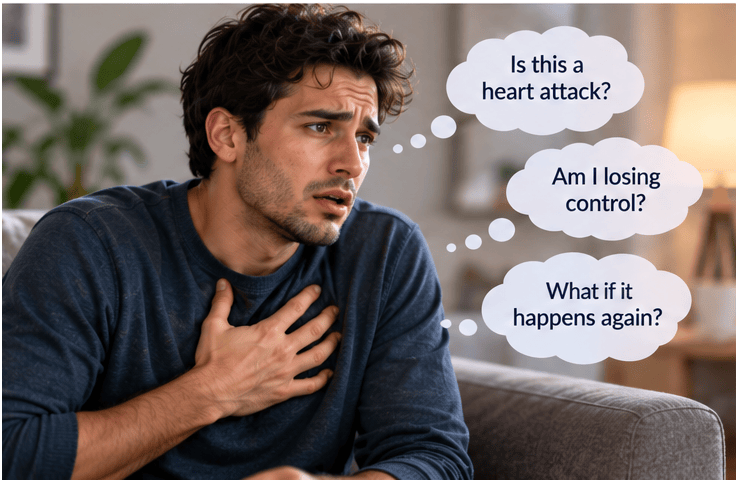
For some people, the symptoms appear so suddenly and feel so physically intense that they believe they are having a heart attack or experiencing another medical emergency.
Other people describe feeling disconnected from themselves or their surroundings. They may fear that they’re losing control, about to faint or somehow “going crazy.”
Even when someone has experienced panic attacks before, another episode can still feel terrifying.
And because panic attacks can sometimes seem to appear without warning, another problem may gradually develop:
fear of the next panic attack.
You may start wondering when it will happen again.
Where will you be?
Will you be driving?
Will you be at work?
What if you’re in a crowded store?
What if you can’t leave?
Eventually, the fear of panic itself can begin influencing everyday decisions.
This is where professional psychological support may help.
Online therapy can provide an accessible way to understand panic symptoms, identify patterns that may be maintaining anxiety and learn strategies for responding differently to frightening sensations and thoughts.
Learn more about Online-Therapy.com’s Panic Attack Program:
https://www.online-therapy.com/panic-attack
What Is a Panic Attack?
A panic attack is an episode involving an intense surge of fear or discomfort that can be accompanied by significant physical and psychological symptoms.
The experience can feel extremely real and immediate.
Physical symptoms may include a rapid or pounding heartbeat, sweating, trembling, dizziness, chest discomfort, shortness of breath, nausea, chills, feelings of heat, tingling or numbness.
Psychological symptoms can be equally frightening.
Some people fear they’re about to lose control.
Others fear dying.
You may experience a sense that the world around you isn’t quite real, sometimes described as derealization.
Another experience, known as depersonalization, can involve feeling detached from yourself.
When these sensations appear suddenly, it’s understandable that someone might interpret them as evidence of something catastrophic.
Panic Symptoms Shouldn’t Automatically Be Assumed to Be Anxiety
This is an important distinction.
Symptoms associated with panic attacks can overlap with symptoms caused by physical medical conditions.
Chest pain, difficulty breathing, fainting, significant changes in heartbeat and other physical symptoms should not automatically be attributed to panic—especially when they’re new, severe, unusual or unexplained.
If you believe you may be experiencing a medical emergency, seek urgent medical attention.
A healthcare professional can determine whether symptoms require medical investigation.
Once appropriate medical causes have been considered, psychological treatment may help when panic attacks are recurring or significantly affecting your life.
Why Do Panic Attacks Feel So Dangerous?
One reason panic attacks can be so frightening is that they activate systems designed to protect you from danger.
Imagine walking around a corner and suddenly seeing something genuinely threatening.
Your body needs to respond quickly.
Your heart rate increases.
Your breathing changes.
Your muscles become ready for action.
Your attention narrows toward the perceived threat.
This is part of the body’s natural alarm response.
During panic, similar sensations can occur even when there isn’t an immediate external danger requiring escape.
Because the sensations themselves are intense, you may interpret them catastrophically.
Your heart begins beating faster.
You think:
“Something is wrong with my heart.”
That thought frightens you.
Fear activates the body’s alarm system further.
Your heartbeat becomes even more noticeable.
Now the thought feels even more convincing.
A cycle can develop in which fear of physical sensations increases the physical sensations themselves.
Understanding this cycle can be an important part of therapy for panic.
The Fear-of-Fear Cycle
After experiencing a frightening panic attack, you may become unusually alert to sensations in your body.
You notice every heartbeat.
Every moment of dizziness gets your attention.
You monitor your breathing.
You become concerned when you feel warm.
A sensation that you might previously have ignored now triggers a thought:
“Is another panic attack starting?”
That thought creates anxiety.
Anxiety produces additional physical sensations.
You notice those sensations.
Your fear increases.
The cycle accelerates.
This is sometimes described as becoming afraid of fear itself.
The original panic attack may have lasted a relatively short time, but the fear of experiencing another one can continue much longer.
When Should You Consider Online Therapy for Panic Attacks?
A single episode of intense anxiety doesn’t necessarily mean you’ll develop an ongoing panic problem.
However, professional support may be worth considering if panic attacks are recurring, causing significant distress or changing the way you live.
Several patterns are particularly worth noticing.
1. You’re Constantly Worried About Another Panic Attack
The attack ends, but the anxiety doesn’t.
Instead, your mind moves to the future.
“When will this happen again?”
“What if I’m alone?”
“What if nobody can help me?”
“What if I can’t escape?”
You may spend large amounts of time monitoring yourself for signs that another attack is beginning.
When fear of future panic starts occupying your day, therapy can help you examine those thoughts and learn a different way of responding to bodily sensations.
2. You’re Avoiding Places Because You’re Afraid of Panicking
Avoidance can develop gradually.
Suppose you experience a panic attack while shopping.
The next time you consider visiting the same store, you remember what happened.
You decide not to go.
Immediately, you feel relieved.
That relief can teach your brain something:
“Avoiding the store kept me safe.”
Soon, you might avoid another store.
Then crowded shopping centers.
Then public transportation.
Perhaps you stop traveling far from home.
Avoidance can expand until fear significantly limits your independence.
If you’re making decisions based primarily on where you believe a panic attack might occur, it may be a good time to seek support.
3. You’re Frequently Checking Your Body for Symptoms
After a panic attack, ordinary bodily sensations can suddenly seem threatening.
Perhaps you repeatedly check your pulse.
You focus closely on your breathing.
You notice tiny changes in balance or temperature.
The more attention you give these sensations, the more noticeable they can become.
Therapy may help you understand how attention, interpretation and anxiety interact.
Importantly, this doesn’t mean ignoring genuinely new or concerning physical symptoms. Appropriate medical assessment remains important when indicated.
4. You Frequently Seek Reassurance
Reassurance can feel extremely helpful in the moment.
You might ask:
“Does my heartbeat seem normal?”
“Do you think I’m going to faint?”
“Are you sure I’m okay?”
Someone reassures you.
Your anxiety decreases.
But soon another sensation appears and you need reassurance again.
Repeated reassurance can sometimes become part of an anxiety-maintaining cycle.
Therapy can help you develop greater confidence in managing anxious thoughts without needing constant external confirmation.
5. Panic Is Affecting Work, Relationships or Everyday Life
Perhaps you’re avoiding meetings because you’re afraid of having an attack in front of colleagues.
Maybe you’ve stopped traveling.
You only visit certain places if someone accompanies you.
You leave social events early.
Or your partner has begun organizing daily life around situations you feel able to tolerate.
At this point, panic isn’t limited to individual episodes.
It’s influencing your lifestyle.
That is a strong reason to consider professional support.
How Can Online Therapy Help With Panic Attacks?
One commonly used psychological approach for panic-related problems is Cognitive Behavioral Therapy (CBT).
CBT examines connections between thoughts, emotions, physical sensations and behaviors.
With panic, this can be particularly useful because the interpretation of physical sensations may play an important role in escalating fear.
Consider this simplified sequence:
Physical sensation: Your heart starts beating quickly.
Thought: “I’m going to have a heart attack.”
Emotion: Intense fear.
Physical response: Your body’s alarm response increases.
Observation: Your heart now feels even faster.
Thought: “I knew something terrible was happening.”
The cycle continues.
CBT can help you identify these patterns and examine the thoughts attached to physical sensations.
Learning to Question Catastrophic Interpretations
Panic can generate extremely convincing thoughts.
“I’m going to collapse.”
“I’m losing control.”
“I can’t breathe.”
“Something terrible is happening.”
“I won’t be able to cope.”
When you’re frightened, these thoughts may feel like facts.
Therapeutic work can help you learn to distinguish between a thought and evidence that the thought is true.
You can begin asking:
What am I predicting?
What evidence am I using?
Have I experienced similar sensations before?
What happened then?
Could there be another explanation for what I’m feeling?
The objective isn’t to dismiss your experience.
The sensations of panic can be genuinely distressing.
Instead, the goal is to change the interpretation that automatically turns an uncomfortable sensation into evidence of catastrophe.
Understanding Physical Sensations
For many people, learning about the body’s anxiety response is surprisingly powerful.
A rapid heartbeat can feel dangerous if you don’t understand why it’s happening.
The same is true of trembling, sweating, dizziness or tingling.
Therapy can help you understand how anxiety may produce physical sensations and why fear can amplify them.
This knowledge alone isn’t always enough to stop panic, but it can make the experience less mysterious.
And when sensations become less mysterious, they may gradually become less frightening.
Reducing Avoidance
If you’ve begun avoiding places because of panic, therapy may involve gradually working toward situations that have become associated with fear.
This should be approached appropriately and, where necessary, with guidance from a qualified professional.
The objective isn’t to throw yourself immediately into your most frightening situation.
Instead, therapeutic work may involve taking manageable steps.
Perhaps you remain somewhere slightly longer than usual.
You travel a little farther from home.
You enter a situation you’ve been avoiding.
Through repeated experiences, you can begin gathering new information.
Instead of learning:
“I survived because I escaped,”
you may gradually learn:
“I experienced anxiety, and I was able to cope with it.”
That distinction can be important.
Why Online Therapy Can Be Particularly Helpful
Panic can make attending traditional appointments difficult.
If you worry about driving, public transportation, crowded waiting rooms or being far from home, simply getting to a therapist’s office may feel like another major challenge.
Online therapy can reduce that initial practical barrier.
You can begin working with a therapist from an appropriate private location where you feel comfortable.
Online-Therapy.com provides structured online therapy based around CBT principles.
Depending on the relevant service and plan, online treatment may include structured therapeutic materials, worksheets, therapist communication and live sessions.
This can allow you to learn about panic, identify patterns and practice psychological strategies between interactions with your therapist.
Explore the Panic Attack Program:
Online Therapy Shouldn’t Become Another Form of Avoidance
There is an important point to consider.
If you’re choosing online therapy because panic makes leaving home frightening, the long-term objective may not necessarily be to remain at home indefinitely.
Online therapy can provide an accessible starting point.
From that starting point, treatment can potentially help you regain activities and independence that panic has restricted.
The goal is not simply to create a life in which you never encounter anxiety.
It’s to develop a different relationship with anxiety so that fear has less control over your decisions.
What Can You Do During a Panic Attack?
If you’ve previously been medically assessed where appropriate and recognize the sensations as part of your established panic pattern, strategies learned in therapy may help you respond differently.
Remind yourself that anxiety sensations can feel intense without automatically meaning catastrophe.
Try to notice what’s happening without fighting every sensation.
Pay attention to your surroundings rather than monitoring every heartbeat.
Use coping or breathing techniques you’ve learned from an appropriate professional.
Most importantly, avoid treating generic advice as a substitute for medical care when symptoms are new or concerning.
If you’re uncertain whether you’re experiencing panic or a medical emergency, seek appropriate medical attention.
Panic Attacks and Agoraphobia
For some people, repeated panic attacks can become associated with fear of situations where escape might feel difficult or help might seem unavailable.
This can contribute to avoiding public transportation, crowds, stores, enclosed spaces, open spaces or being outside the home alone.
When this pattern becomes significant, professional assessment is particularly useful.
Treatment can help address both panic symptoms and the avoidance that has developed around them.
The earlier you recognize that your world is becoming smaller because of fear, the sooner you can consider getting support.
You Don’t Have to Wait Until Panic Controls Your Life
It’s easy to tell yourself:
“I’ll get help if it gets worse.”
But “worse” can arrive gradually.
You stop visiting one place.
Then another.
You start carrying reassurance items everywhere.
You need someone to accompany you.
You constantly monitor your body.
You organize your schedule around avoiding situations where panic might occur.
Eventually, fear can become a major factor in everyday decision-making.
You don’t have to wait for that point.
If panic attacks are recurring, distressing or changing your behavior, seeking professional advice is reasonable.
Taking the First Step Toward Managing Panic
Panic attacks can feel unpredictable and frightening, but there are established psychological approaches for helping people understand and manage panic-related symptoms.
The first step is often understanding the cycle.
Physical sensations trigger frightening thoughts.
Those thoughts increase anxiety.
Anxiety intensifies physical sensations.
Avoidance provides temporary relief but can reinforce fear.
Therapy can help you begin interrupting that cycle.
You can learn to recognize catastrophic thinking.
You can understand your body’s anxiety response.
You can reduce unhelpful monitoring and reassurance behaviors.
And, where appropriate, you can gradually return to situations that fear has encouraged you to avoid.
Online therapy makes it possible to begin that work remotely.

Get Support Wherever You Are
If panic attacks are affecting your confidence, independence or everyday life, professional support may help you understand what’s happening and develop practical strategies for managing anxiety.
Learn more about Online-Therapy.com’s online program for panic attacks:
You don’t have to wait until fear has taken over more of your life before exploring support.
Understanding panic is an important first step toward changing how you respond to it.
Important Safety Information
Symptoms associated with panic attacks can overlap with serious medical conditions.
New, severe or unexplained chest pain, significant breathing difficulty, fainting, unusual heart symptoms or other potentially serious physical symptoms require appropriate medical attention.
If you believe you may be experiencing a medical emergency, contact your local emergency service.
Online therapy is not a substitute for emergency medical or psychiatric care.
If you’re in immediate danger or experiencing a mental-health crisis, seek urgent help through an appropriate local emergency or crisis service.


Leave a Reply