



:
How It Can Help and When to Seek Support
Have you ever felt nervous before giving a presentation, attending a party or meeting someone for the first time?
Most people have.
Feeling self-conscious occasionally is a normal part of life. You might worry about saying the wrong thing during an important meeting or feel butterflies in your stomach before walking into a room full of strangers.
Usually, those feelings are temporary.
But what happens when fear of other people’s attention begins influencing the way you live your life?
Perhaps you constantly worry that people are watching you.
Maybe you replay conversations afterward, analyzing everything you said and wondering whether you embarrassed yourself.
You might avoid parties, meetings, dates, restaurants, phone calls or public speaking because the anxiety feels overwhelming.
Even the thought of an upcoming social situation may trigger physical reactions such as a pounding heart, sweating, trembling, blushing, dizziness or tightness in your chest.
When fear of social situations becomes persistent and begins interfering with your relationships, education, career or everyday activities, it may be worth considering whether social anxiety is playing a role.
Online therapy provides one way to seek professional support without having to begin with a traditional face-to-face appointment.
Learn more about Online-Therapy.com’s Social Anxiety Program:
https://www.online-therapy.com/social-anxiety
What Is Social Anxiety?
Social anxiety involves an intense fear of social situations in which you believe you could be watched, evaluated, embarrassed, criticized or rejected.
It is considerably more than simply being introverted or occasionally shy.
Someone who is shy may feel uncomfortable meeting new people but still attend social events and gradually become more relaxed.
For someone experiencing significant social anxiety, the anticipation of an event itself can become extremely distressing.
You might spend days worrying about a meeting that will last only an hour.
You may think repeatedly about everything that could go wrong.
“What if I say something stupid?”
“What if people notice that I’m nervous?”
“What if I blush?”
“What if nobody talks to me?”
“What if everyone thinks I’m boring?”
These thoughts can make an ordinary social situation feel threatening.
Social Anxiety Can Look Different for Different People
Social anxiety doesn’t necessarily mean being frightened of every social interaction.
One person may feel comfortable talking with close friends but become extremely anxious around strangers.
Another may enjoy social gatherings but find public speaking terrifying.
Someone else might be particularly uncomfortable eating in front of people, making telephone calls, attending job interviews or speaking during meetings.
Common situations that can trigger social anxiety include meeting unfamiliar people, dating, attending parties, speaking in groups, giving presentations, talking to authority figures, making phone calls, eating in public, being observed while completing a task or expressing an opinion when other people might disagree.
The common element is often fear of negative evaluation.
You may believe that other people will notice something embarrassing about you and judge you negatively because of it.
What Does Social Anxiety Feel Like?
Social anxiety can affect your thoughts, emotions, behavior and body simultaneously.
Imagine you’ve been asked to give a presentation at work.
The presentation isn’t until Friday.
It’s Monday morning.
You immediately begin thinking:
“I’m going to mess this up.”
“Everyone will notice how nervous I am.”
“I’ll forget what I’m saying.”
“My face will go red.”
Those thoughts generate anxiety.
Your body responds.
Your heart may begin beating faster. Your muscles become tense. Your stomach feels uncomfortable.
By Thursday night, you may struggle to sleep.
On Friday morning, you consider calling in sick.
If you manage to avoid the presentation, something interesting happens.
Your anxiety immediately decreases.
That relief can feel enormous.
Unfortunately, it can also strengthen the connection between avoidance and safety.

Why Avoidance Can Keep Social Anxiety Going
Avoidance makes perfect sense when something frightens us.
If attending a party produces intense anxiety, staying home seems like an obvious solution.
And in the short term, it works.
You don’t attend the party.
Your anxiety decreases.
Your brain may then learn:
“Avoiding social situations keeps me safe.”
The next invitation arrives.
Avoidance becomes even more tempting.
Over time, you may begin avoiding more situations.
Perhaps you stop attending work events.
Then you avoid restaurants.
You turn down invitations.
You communicate by text instead of calling people.
You stop expressing opinions during meetings.
You choose jobs that don’t require presentations.
Each individual decision may seem relatively small.
Together, however, they can begin determining the shape of your life.
This is one reason treatment for social anxiety often involves learning to respond differently to feared situations rather than simply finding better ways to avoid them.
When Should You Consider Online Therapy for Social Anxiety?
You don’t have to wait until anxiety becomes unbearable before seeking support.
One useful question is:
“Is anxiety preventing me from living the life I want to live?”
If the answer is frequently yes, talking with a mental-health professional may be worthwhile.
There are several situations in which online therapy may be particularly worth considering.
1. You’re Regularly Avoiding Social Situations
Perhaps you’ve started turning down invitations even though part of you would like to attend.
Maybe you’re avoiding meetings, interviews, dates or networking events.
You might choose not to speak because you’re frightened of attracting attention.
Avoidance becomes particularly important when it begins limiting opportunities that matter to you.
You don’t necessarily need to become the most outgoing person in the room.
The goal is to prevent fear from automatically making important decisions for you.
2. You Spend Days Worrying About Upcoming Events
Sometimes the actual social event isn’t the most difficult part.
The anticipation is.
A ten-minute presentation might generate a week of worry.
You may repeatedly imagine embarrassing scenarios, mentally rehearse conversations or search for excuses to cancel.
This is known as anticipatory anxiety.
If worrying about social situations consumes considerably more time and energy than the situations themselves, it may be useful to explore those patterns in therapy.
3. You Constantly Feel Watched or Judged
When experiencing social anxiety, your attention may become intensely focused on how you appear to other people.
You might wonder whether they can see your hands shaking.
Perhaps you’re convinced everyone noticed when you stumbled over a sentence.
You may interpret someone’s neutral facial expression as evidence that they dislike you.
Therapy can help you examine these assumptions rather than automatically treating anxious predictions as facts.
4. Physical Anxiety Symptoms Are Distressing You
Social anxiety can produce very real physical sensations.
These may include a pounding or rapid heartbeat, sweating, trembling, blushing, nausea, dizziness, muscle tension or a sensation of tightness in the chest.
Sometimes people become anxious about the symptoms themselves.
You may think:
“Everyone can see that I’m blushing.”
That thought creates additional anxiety.
The increased anxiety may make you blush more.
Now you’re even more worried that people are noticing.
This can become a self-reinforcing cycle.
Learning to understand your anxiety response can make these sensations feel less mysterious and help you develop more constructive ways of responding to them.
New, severe or unexplained physical symptoms should also be medically assessed when appropriate rather than automatically being attributed to anxiety.
5. Social Anxiety Is Affecting Your Career
Think about how many professional activities involve interacting with other people.
Job interviews.
Presentations.
Meetings.
Networking.
Telephone calls.
Talking with managers.
Sharing ideas.
Asking questions.
Negotiating.
If fear repeatedly prevents you from participating in these situations, social anxiety can influence your professional development.
Perhaps you have excellent ideas but never share them.
Maybe you avoid applying for a promotion because it would involve presentations.
Or you turn down opportunities that require meeting unfamiliar people.
Therapy can help you work on the anxiety associated with these situations rather than simply structuring your career around avoiding them.
6. Anxiety Is Affecting Friendships or Relationships
Social anxiety can be lonely.
You may want friendships and relationships while simultaneously finding the process of developing them frightening.
Someone invites you somewhere.
You want to go.
Then anxiety begins generating reasons not to.
You cancel.
The immediate anxiety disappears, but later you feel isolated or disappointed.
Over time, other people may mistakenly interpret avoidance as disinterest.
If anxiety is creating a barrier between you and the relationships you want, that can be an important reason to seek support.
How Can Online Therapy Help With Social Anxiety?
One commonly used psychological treatment for social anxiety is Cognitive Behavioral Therapy (CBT).
CBT focuses on relationships between thoughts, emotions and behaviors.
Consider this example:
Situation: You’re invited to a party.
Thought: “I’ll have nothing interesting to say and everyone will think I’m awkward.”
Emotion: Anxiety and embarrassment.
Physical response: Increased heart rate and muscle tension.
Behavior: You decline the invitation.
Short-term consequence: Anxiety decreases.
Long-term consequence: You never get an opportunity to discover whether your prediction was accurate.
CBT can help you identify and examine patterns like this.
Instead of automatically assuming your anxious thought is true, you can learn to question it.
What evidence supports the prediction?
What evidence doesn’t?
Are there alternative explanations?
What would you tell a friend who had the same thought?
The objective isn’t to replace every anxious thought with unrealistic positivity.
It’s to develop a more balanced and flexible way of interpreting situations.

Learning to Challenge Negative Predictions
Social anxiety is often filled with predictions.
“Everyone will notice.”
“Nobody will know what to say to me.”
“I’ll embarrass myself.”
“They’ll think I’m strange.”
The difficulty is that avoidance can prevent you from discovering whether those predictions are accurate.
Suppose you’re convinced you’ll say something embarrassing at a social event.
If you never attend, the prediction remains untested.
Therapeutic work can help you recognize these automatic predictions and gradually test assumptions in appropriate, manageable ways.
Over time, real experiences can provide information that anxious predictions alone cannot.
Gradually Facing Feared Situations
Treatment for anxiety can involve gradually approaching feared situations rather than avoiding them.
This doesn’t necessarily mean immediately doing the thing that frightens you most.
A gradual approach may involve creating a hierarchy of situations from less anxiety-provoking to more challenging.
For example, depending on the individual, steps might involve making brief eye contact, asking a shop assistant a question, making a short telephone call, starting a conversation, attending a small gathering and eventually tackling more challenging situations.
The specific approach should be appropriate to the individual and, where needed, developed with a qualified professional.
The important principle is that confidence often develops through experience rather than waiting until all anxiety disappears first.
Why Consider Online Therapy?
For someone with social anxiety, attending a therapist’s office can itself feel intimidating.
You may worry about the journey, sitting in a waiting room, meeting someone new or discussing personal experiences face-to-face.
Online therapy can remove some of those initial practical barriers.
You can participate from a private location where you feel comfortable.
Online-Therapy.com provides a structured online therapy program based on CBT principles, alongside therapist support.
Depending on the applicable plan and service, the platform can incorporate structured therapy materials, worksheets, messaging and live interaction.
This combination can allow you to learn about your patterns, complete exercises and work with a therapist remotely.
Explore the Social Anxiety Program:
Online Therapy Doesn’t Mean Avoiding Social Situations Forever
There’s an important distinction here.
Choosing online therapy because it makes professional help more accessible isn’t the same thing as deciding that the solution to social anxiety is to conduct your entire life online.
The purpose of therapy may eventually include helping you participate more freely in situations that currently frighten you.
Online therapy can provide an accessible place to begin that work.
You can learn about anxiety, identify thinking patterns, develop coping strategies and work toward gradually confronting appropriate fears.
The goal isn’t necessarily to eliminate every nervous feeling.
The goal is to reduce the extent to which anxiety controls your choices.
When Online Therapy May Not Be Enough
Online therapy isn’t the appropriate solution for every situation.
Social anxiety symptoms can overlap with other mental-health or medical concerns, and a professional assessment may sometimes be needed.
If you’re uncertain about your symptoms, they’re severe, they’re rapidly worsening, or they’re significantly affecting your ability to function, consider speaking with an appropriately qualified healthcare or mental-health professional.
Likewise, symptoms such as chest pain, fainting or significant breathing difficulty shouldn’t automatically be assumed to be anxiety, particularly if they’re new or unexplained. Seek appropriate medical care.
And if you’re in immediate danger, experiencing a mental-health emergency, or thinking about harming yourself, seek urgent help through your local emergency or crisis services rather than relying on a routine online therapy service.
You Don’t Have to Wait Until Social Anxiety Takes Over
One of the biggest misconceptions about seeking therapy is that you need to wait until your problem becomes severe enough to “justify” getting help.
You don’t.
Perhaps you’re still attending work and maintaining relationships, but every social interaction requires enormous mental effort.
Maybe nobody around you realizes how anxious you feel.
You may appear calm while internally analyzing every word you say.
The impact of anxiety isn’t determined solely by whether other people can see it.
If social anxiety is regularly causing distress, limiting your opportunities or affecting your quality of life, exploring support is reasonable.

Taking the First Step
Social anxiety can create an uncomfortable contradiction.
You want things that involve other people—friendships, relationships, professional opportunities, new experiences—but anxiety encourages you to avoid the very situations that could provide them.
Breaking that cycle doesn’t require becoming fearless overnight.
It begins with understanding what is happening.
You can learn to recognize anxious predictions.
You can notice avoidance.
You can examine assumptions about how other people see you.
And, with appropriate support, you can gradually develop different responses to situations that currently feel overwhelming.
Online therapy offers one way to begin that process from a familiar environment.
If fear of being watched, judged or embarrassed has started influencing your choices, relationships, career or everyday activities, it
Online Therapy for Social Anxiety: How It Can Help and When to Seek Support
Have you ever felt nervous before giving a presentation, attending a party or meeting someone for the first time?
Most people have.
Feeling self-conscious occasionally is a normal part of life. You might worry about saying the wrong thing during an important meeting or feel butterflies in your stomach before walking into a room full of strangers.
Usually, those feelings are temporary.
But what happens when fear of other people’s attention begins influencing the way you live your life?
Perhaps you constantly worry that people are watching you.
Maybe you replay conversations afterward, analyzing everything you said and wondering whether you embarrassed yourself.
You might avoid parties, meetings, dates, restaurants, phone calls or public speaking because the anxiety feels overwhelming.
Even the thought of an upcoming social situation may trigger physical reactions such as a pounding heart, sweating, trembling, blushing, dizziness or tightness in your chest.
When fear of social situations becomes persistent and begins interfering with your relationships, education, career or everyday activities, it may be worth considering whether social anxiety is playing a role.
Online therapy provides one way to seek professional support without having to begin with a traditional face-to-face appointment.
Learn more about Online-Therapy.com’s Social Anxiety Program:
https://www.online-therapy.com/social-anxiety
What Is Social Anxiety?
Social anxiety involves an intense fear of social situations in which you believe you could be watched, evaluated, embarrassed, criticized or rejected.
It is considerably more than simply being introverted or occasionally shy.
Someone who is shy may feel uncomfortable meeting new people but still attend social events and gradually become more relaxed.
For someone experiencing significant social anxiety, the anticipation of an event itself can become extremely distressing.
You might spend days worrying about a meeting that will last only an hour.
You may think repeatedly about everything that could go wrong.
“What if I say something stupid?”
“What if people notice that I’m nervous?”
“What if I blush?”
“What if nobody talks to me?”
“What if everyone thinks I’m boring?”
These thoughts can make an ordinary social situation feel threatening.
Social Anxiety Can Look Different for Different People
Social anxiety doesn’t necessarily mean being frightened of every social interaction.
One person may feel comfortable talking with close friends but become extremely anxious around strangers.
Another may enjoy social gatherings but find public speaking terrifying.
Someone else might be particularly uncomfortable eating in front of people, making telephone calls, attending job interviews or speaking during meetings.
Common situations that can trigger social anxiety include meeting unfamiliar people, dating, attending parties, speaking in groups, giving presentations, talking to authority figures, making phone calls, eating in public, being observed while completing a task or expressing an opinion when other people might disagree.
The common element is often fear of negative evaluation.
You may believe that other people will notice something embarrassing about you and judge you negatively because of it.
What Does Social Anxiety Feel Like?
Social anxiety can affect your thoughts, emotions, behavior and body simultaneously.
Imagine you’ve been asked to give a presentation at work.
The presentation isn’t until Friday.
It’s Monday morning.
You immediately begin thinking:
“I’m going to mess this up.”
“Everyone will notice how nervous I am.”
“I’ll forget what I’m saying.”
“My face will go red.”
Those thoughts generate anxiety.
Your body responds.
Your heart may begin beating faster. Your muscles become tense. Your stomach feels uncomfortable.
By Thursday night, you may struggle to sleep.
On Friday morning, you consider calling in sick.
If you manage to avoid the presentation, something interesting happens.
Your anxiety immediately decreases.
That relief can feel enormous.
Unfortunately, it can also strengthen the connection between avoidance and safety.
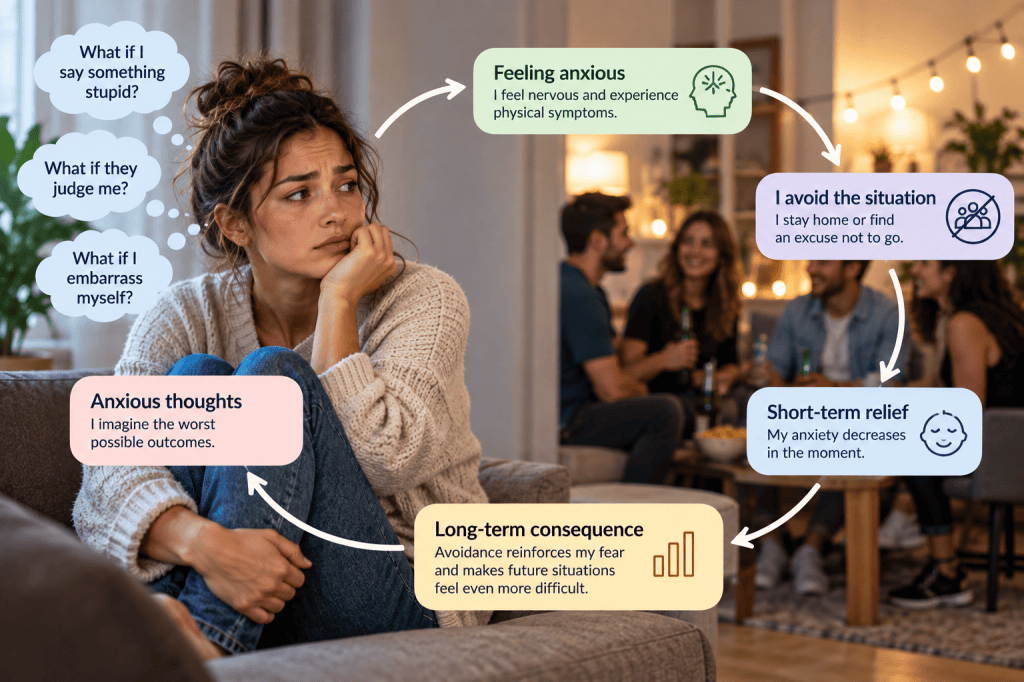
Why Avoidance Can Keep Social Anxiety Going
Avoidance makes perfect sense when something frightens us.
If attending a party produces intense anxiety, staying home seems like an obvious solution.
And in the short term, it works.
You don’t attend the party.
Your anxiety decreases.
Your brain may then learn:
“Avoiding social situations keeps me safe.”
The next invitation arrives.
Avoidance becomes even more tempting.
Over time, you may begin avoiding more situations.
Perhaps you stop attending work events.
Then you avoid restaurants.
You turn down invitations.
You communicate by text instead of calling people.
You stop expressing opinions during meetings.
You choose jobs that don’t require presentations.
Each individual decision may seem relatively small.
Together, however, they can begin determining the shape of your life.
This is one reason treatment for social anxiety often involves learning to respond differently to feared situations rather than simply finding better ways to avoid them.
When Should You Consider Online Therapy for Social Anxiety?
You don’t have to wait until anxiety becomes unbearable before seeking support.
One useful question is:
“Is anxiety preventing me from living the life I want to live?”
If the answer is frequently yes, talking with a mental-health professional may be worthwhile.
There are several situations in which online therapy may be particularly worth considering.


Leave a Reply