



When to Get Help and Why It Can Help
Meta Title: Anger Management Online: Therapy, Help & Techniques
Meta Description: Learn how anger management online works, when anger may be becoming a problem, and how online therapy can help you understand triggers and manage anger.
Primary Keyword: anger management online
Secondary Keywords: online anger management, anger management therapy, online therapy for anger, anger management counselling, anger therapy online, help with anger, anger management techniques, controlling anger, managing anger, CBT for anger
Feeling angry is a normal part of being human. Someone cuts you off in traffic. A colleague ignores something important you have said. Your plans suddenly fall apart. A disagreement with your partner becomes more heated than expected.
In situations like these, anger can appear almost instantly.
Your heart may beat faster, your muscles tighten and your thoughts begin racing. You might feel an overwhelming urge to argue, shout or respond immediately.
Anger itself is not necessarily a problem. It is a natural emotion that can alert us when something feels unfair, threatening, frustrating or wrong. In some circumstances, anger can motivate us to solve problems, establish boundaries or stand up for ourselves.
The difficulty begins when anger becomes excessive, frequent or difficult to control.
If small frustrations regularly turn into major arguments, you say things you later regret, relationships are becoming strained or anger is affecting your work and everyday life, it may be time to examine what is happening.
Anger management online provides one way to do this. Through online therapy and structured anger-management techniques, you can learn to recognise your triggers, understand what happens between feeling angry and reacting to it, and develop healthier ways of responding.
What Is Anger Management Online?
Anger management online refers to professional support, therapy or structured psychological strategies delivered remotely to help people understand and manage problematic anger.
Depending on the service, support may involve live video sessions, messaging, worksheets, journals, educational materials or exercises completed between therapy sessions.
The purpose of anger management is not to make you incapable of feeling angry.
Trying to eliminate anger completely would be neither realistic nor particularly useful. Anger is a normal emotional response.
Instead, anger management focuses on recognising anger earlier and deciding how to respond before the emotion takes control of your behaviour.
Imagine that another driver suddenly pulls into your lane.
You immediately think:
“What an idiot! They could have caused an accident.”
Your heart starts pounding. Your hands grip the steering wheel. Within seconds, you are shouting, sounding the horn or feeling tempted to retaliate.
Online anger management therapy can help you examine what happened during those few seconds.
What triggered the anger? What did you think? What happened physically? What action did you feel compelled to take?
Learning to recognise that sequence can create an opportunity to respond differently.
When Does Normal Anger Become a Problem?
Everyone gets angry occasionally.
Having an argument, becoming irritated in traffic or losing patience during a stressful day does not automatically mean that you have an anger problem.
The more useful question is whether anger is causing harm or repeatedly interfering with your life.
Problematic anger can take many forms.
Some people shout, insult others or become openly confrontational. Others become sarcastic or deliberately hurtful. Some withdraw completely and refuse to communicate.
Anger can also remain largely internal. Someone may appear calm while spending hours replaying an argument, imagining confrontations or holding onto resentment.
You might benefit from exploring anger management if you frequently lose your temper, feel unable to calm down after becoming angry or repeatedly regret what you have said or done.
Other warning signs can include arguments damaging important relationships, anger creating difficulties at work, becoming disproportionately angry about relatively minor frustrations or feeling as though other people constantly provoke you.
The issue is not simply how often you become angry.
It is what happens because of that anger.
How Does Anger Management Online Work?
Effective anger management usually starts with understanding patterns.
Anger can feel immediate and automatic, but there is often a sequence of events underneath it.
A simplified version might look like this:
Trigger → Thought → Physical reaction → Emotion → Behaviour → Consequence
Suppose your partner forgets to do something you asked them to do.
The trigger is discovering that the task has not been completed.
Your immediate thought might be:
“They never listen to me. They obviously don’t care what I say.”
You notice your heart beating faster and tension in your shoulders.
Anger rises.
You start shouting.
Your partner becomes defensive, and the discussion turns into an argument.
Later, both of you feel hurt and frustrated.
Anger management therapy can help you slow this sequence down and examine each stage.
Was the original interpretation the only possible explanation? Could your partner simply have forgotten? Did shouting help solve the original problem? What could you do differently the next time you notice the same physical warning signs?
These questions are not intended to prove that you should never be angry.
They are designed to help separate the emotion from the reaction.
Understanding Your Anger Triggers
One important part of anger management online is identifying triggers.
Triggers vary considerably between people.
Common examples can include feeling ignored, being criticised, believing someone is disrespecting you, traffic, workplace stress, financial problems, relationship difficulties, tiredness or plans changing unexpectedly.
Sometimes the immediate trigger is only part of the story.
Imagine that you arrive home after a difficult day. You have slept badly, missed lunch and spent hours dealing with problems at work.
You then discover that someone has left dirty dishes in the kitchen.
On another day, you might barely notice.
Today, you explode.
The dishes were the immediate trigger, but stress, hunger, tiredness and frustration may all have lowered your ability to cope with one more irritation.
Learning your triggers and vulnerabilities can help you recognise situations in which anger is more likely.
Recognising the Early Warning Signs of Anger
Anger usually produces physical and psychological warning signs before it reaches its peak.
These can include:
- A faster heartbeat
- Muscle tension
- Clenching your jaw or fists
- Feeling hot or flushed
- Faster breathing
- Sweating
- Raising your voice
- Pacing or becoming physically restless
- Racing thoughts
- Feeling an urgent need to respond
- Repeatedly thinking about what someone has done wrong
Recognising these signs early can be extremely valuable.
If you only realise you are angry after you have shouted or said something hurtful, your options are limited.
If you recognise the warning signs earlier, there may be time to change what happens next.
That might involve pausing a conversation, changing your breathing, challenging an assumption or agreeing to continue a difficult discussion when everyone is calmer.
How CBT Can Help With Anger
Cognitive behavioral therapy, or CBT, is one therapeutic approach that can be used to explore problematic anger.
CBT examines relationships between thoughts, emotions and behaviours.
This can be particularly relevant to anger because the way we interpret an event can dramatically influence our emotional response.
Imagine that someone fails to respond to your message.
One interpretation is:
“They’re deliberately ignoring me.”
Another is:
“They’re probably busy.”
The event is identical. The interpretation is different.
The first interpretation might produce anger and resentment. The second may result in little emotional reaction.
This does not mean that every angry thought is inaccurate.
Sometimes people genuinely behave unfairly, inconsiderately or disrespectfully.
The goal is to determine whether your interpretation is reasonable and whether your response is useful.
Online therapy for anger may help you notice automatic thoughts, examine assumptions and consider alternative explanations before acting.
Learning to Pause Before Reacting
One of the simplest ideas in anger management can also be one of the hardest to practise: creating a gap between feeling and action.
Anger creates urgency.
It tells you that something needs to happen right now.
You need to send that message.
You need to prove your point.
You need to tell the other person exactly what you think.
But immediate reactions often create consequences that last much longer than the anger itself.
Learning to pause gives the intensity of the emotion an opportunity to decrease.
This might mean taking several slow breaths, counting before responding, temporarily leaving an argument or writing down what you want to say before deciding whether to say it.
The purpose is not avoidance.
If an important issue needs discussing, you can still discuss it.
The difference is that you are choosing when and how to have the conversation rather than allowing anger to make that choice for you.
Communication and Anger Management
Many anger problems become communication problems.
A person may have a legitimate concern but express it in a way that makes productive discussion almost impossible.
Compare:
“You never listen to me. You’re completely selfish.”
with:
“I was frustrated when that happened because I felt like what I’d said wasn’t being taken seriously.”
Both statements communicate dissatisfaction.
But the second focuses more clearly on the problem rather than attacking the other person’s character.
Anger management therapy can help people practise more assertive communication.
Assertiveness is different from aggression.
Aggressive communication attempts to dominate, intimidate or attack. Passive communication can involve avoiding your needs entirely. Assertive communication aims to express concerns clearly while respecting both yourself and the other person.
This can be especially valuable when anger repeatedly causes relationship or workplace conflicts.
Why Choose Anger Management Online?
Convenience is one of the main reasons people explore online anger management.
Traditional therapy can involve travelling to appointments, waiting rooms and arranging your day around a fixed location.
Online therapy may allow you to participate from home or another suitable private location.
This can make support easier to fit around work, family responsibilities and other commitments.
Online formats can also make it easier to record anger patterns between sessions.
Instead of trying to remember an argument several days later, you may be able to write down what happened while the details are still fresh.
What triggered you?
What were you thinking?
How intense was your anger?
How did you respond?
What happened afterward?
Keeping track of these patterns can provide useful material to explore during therapy.
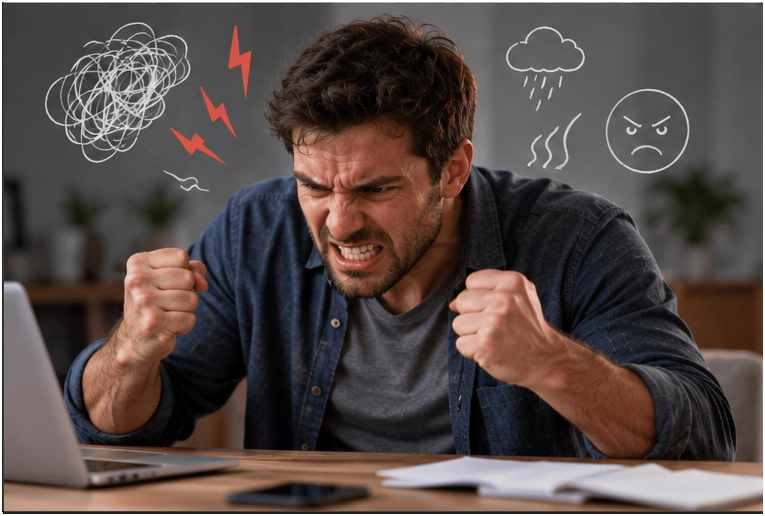
Can Online Anger Management Help Relationships?
Uncontrolled anger can place considerable pressure on relationships.
Arguments can become repetitive. Small disagreements turn into larger conflicts. Partners, relatives or friends may start avoiding certain subjects because they are worried about how the conversation will develop.
Over time, this can damage trust and communication.
Learning to manage anger can help change these patterns.
For example, therapy may help you distinguish between expressing frustration and attacking another person.
You can learn to recognise when a discussion is becoming unproductive and when taking a temporary break might be more useful than continuing to argue.
You may also learn to listen to what the other person is actually saying rather than mentally preparing your next response while they speak.
These skills do not guarantee that disagreements disappear.
Healthy relationships can include disagreement.
The aim is to disagree without allowing every conflict to become destructive.
Anger Management at Work
Workplaces provide plenty of potential anger triggers.
Deadlines, difficult colleagues, demanding customers, criticism, heavy workloads and disagreements with managers can all create frustration.
Reacting impulsively can have significant consequences.
An angry email sent in thirty seconds can create a problem that takes weeks to repair.
Online anger management can help you develop strategies for handling workplace frustration more deliberately.
That could include waiting before responding to a difficult message, asking for clarification rather than assuming someone’s intention or preparing for conversations that you know are likely to be challenging.
The goal is not to tolerate genuinely inappropriate treatment.
It is to respond in a way that protects your interests rather than undermining them.
Stress, Sleep and Anger
Anger does not exist in isolation.
Stress, tiredness and other emotional pressures can influence how easily you become irritated.
When you are exhausted, overwhelmed or under prolonged stress, relatively small frustrations can feel much bigger.
This is why anger management may involve looking beyond individual angry incidents.
What was happening in your life that week?
Were you sleeping adequately?
Were you dealing with unusual pressure at work?
Had several frustrating things happened before the incident?
Understanding these wider patterns can make anger feel less unpredictable.
How to Get the Most From Online Anger Management
Therapy is usually most useful when you actively participate.
Start paying attention to your anger rather than only regretting it afterward.
Notice what situations trigger you, what thoughts appear and what happens physically.
It can help to keep an anger journal.
After an incident, record what happened, how strongly you felt angry, what you thought, how you responded and what consequences followed.
Try to be open during therapy, including about reactions that you may feel embarrassed about.
A therapist needs an accurate picture of what is happening in order to help you understand it.
Practising strategies between sessions can also be important.
Understanding an anger-management technique intellectually is different from being able to use it during a difficult moment.
Like many skills, responding differently to anger can require repetition.
When Should You Seek Help for Anger?
You do not need to wait for a major crisis before seeking support.
Consider talking to a qualified professional if anger feels increasingly difficult to control or repeatedly causes consequences you regret.
Professional support may be particularly important if anger is affecting your relationships, employment, parenting or ability to function normally.
If anger involves threats, violence or an immediate risk that you may harm yourself or someone else, routine online anger management is not an appropriate substitute for urgent professional or emergency support.
How Long Does Anger Management Take?
There is no universal answer.
Some people may benefit from a structured short-term programme, while others have more complicated patterns that require longer-term therapeutic work.
The duration can depend on how long anger has been causing problems, the situations involved, other emotional difficulties and how consistently new skills are practised.
It can also be helpful to think about progress in practical terms.
Are arguments becoming less frequent?
Do you recognise anger earlier?
Can you pause before responding?
Are you saying fewer things that you later regret?
Are difficult conversations becoming more productive?
Changes like these can be meaningful signs of progress even if you still become angry sometimes.
Finding the Right Online Anger Management Support
Not every online service works in the same way.
Before beginning, consider who provides the support, their professional qualifications, the therapeutic approaches offered and how sessions are delivered.
It is also sensible to understand costs, privacy practices, cancellation arrangements and what happens if you need support outside normal sessions.
The relationship with your therapist matters as well.
You should feel able to discuss difficult incidents without hiding important details because you are worried about embarrassment.
At the same time, effective therapy is not necessarily about having someone agree with everything you say. A therapist may help you question assumptions and recognise behaviours that are contributing to problems.
That process can sometimes feel challenging, but it can also create opportunities for meaningful change.
Final Thoughts on Anger Management Online
Anger is not automatically unhealthy.
It can tell you that something matters, that a boundary has been crossed or that a situation needs attention.
The problem begins when anger controls what happens next.
Repeated shouting, aggressive communication, impulsive reactions and lingering resentment can damage relationships, careers and overall wellbeing.
Anger management online offers a convenient way to explore these patterns with professional support.
Therapy can help you recognise triggers, notice the physical warning signs of anger, examine automatic thoughts, communicate more effectively and create a pause between emotion and action.
The objective is not to become someone who never gets angry.
It is to become better at deciding what you do when anger appears.
That distinction can make an enormous difference.
Frequently Asked Questions About Anger Management Online
Does online anger management work?
Online anger management can provide structured support for understanding triggers, thoughts and behaviours associated with problematic anger. How helpful it is will depend on factors such as your circumstances, the nature of the problem, the therapeutic approach and your participation in the process.
What happens in online anger management therapy?
Therapy may involve identifying anger triggers, recognising physical warning signs, examining automatic thoughts and developing healthier communication and coping strategies. You may also complete exercises or keep records of anger incidents between sessions.
Is feeling angry unhealthy?
No. Anger is a normal human emotion. The concern is usually not the existence of anger itself but its intensity, frequency and consequences. Anger can become problematic when it regularly leads to destructive behaviour or interferes with relationships, work or everyday life.
Can CBT help with anger management?
CBT can be used to examine how thoughts and interpretations contribute to emotional and behavioural responses. For anger, this may involve identifying automatic assumptions, evaluating them and developing alternative ways of responding.
What are some common anger triggers?
Triggers differ between individuals but can include criticism, feeling ignored, perceived disrespect, traffic, relationship disagreements, workplace stress, financial pressure and unexpected changes. Stress and lack of sleep can also make some people more vulnerable to irritability.
Can anger management help relationships?
Anger management can help people develop communication and emotional-regulation skills that may make disagreements more constructive. This can include learning to recognise escalation, pause heated conversations and communicate concerns more assertively.
How do I know if I need help managing anger?
Consider professional support if anger regularly feels uncontrollable, leads to behaviour you regret, damages relationships, creates workplace problems or causes people around you to feel unsafe. You do not have to wait for the problem to become severe before seeking help.
Can I learn anger management online from home?
Yes. Depending on the provider, online anger management may involve remote therapy sessions, digital exercises, worksheets, journaling and other resources that can be accessed from home.
How quickly can anger management help?
There is no fixed timeline. Progress depends on the individual, the causes and patterns associated with their anger, the type of therapy being used and how consistently strategies are practised between sessions.

What is the goal of anger management?
The goal is generally not to eliminate anger. Instead, anger management helps you recognise the emotion earlier, understand what triggers it and develop more constructive ways of responding so that anger has less control over your behaviour.


Leave a Reply