


How It Works, When to Seek Help and Why It Can Help
Meta Title: Online Therapy for Agoraphobia: How It Can Help
Meta Description: Learn how online therapy for agoraphobia works, when to seek help, and how therapy can address avoidance, panic, fear and anxiety in everyday situations.
Primary Keyword: online therapy for agoraphobia
Secondary Keywords: agoraphobia therapy online, online agoraphobia treatment, therapy for agoraphobia, help for agoraphobia, CBT for agoraphobia, agoraphobia and panic attacks, exposure therapy for agoraphobia, overcoming agoraphobia
Agoraphobia can make ordinary activities feel extraordinarily difficult.
Going to a supermarket, travelling on public transport, sitting in a crowded restaurant or simply being away from home may create intense anxiety. For some people, the fear becomes so strong that they begin arranging more and more of their lives around avoiding particular places or situations.
Agoraphobia is an anxiety disorder involving fear and anxiety about situations in which escaping might feel difficult or help might not be readily available if distressing symptoms occur.
For some people, the problem may be connected with previous panic attacks. Someone who has experienced intense panic in a public place may become frightened that the same thing will happen again.
Avoiding that location can initially feel like a sensible solution.
Then another place starts to feel dangerous.
And another.
Over time, a person’s world can become increasingly restricted.
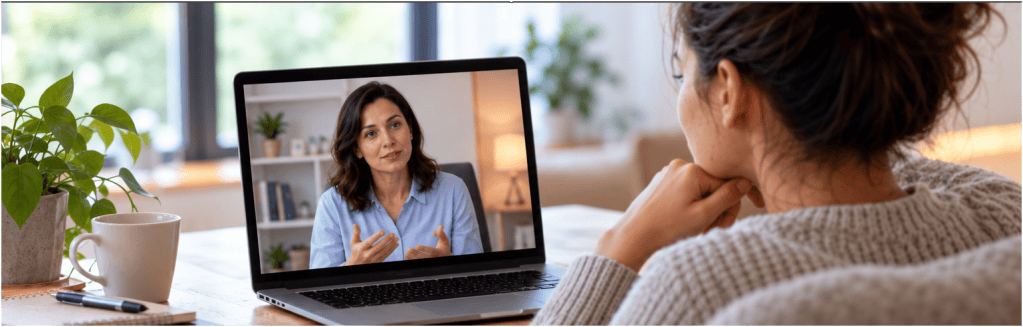
Online therapy for agoraphobia provides an accessible way to begin understanding this cycle and developing strategies for gradually changing it. Because therapy can take place remotely, it may also provide a practical starting point for people who currently find travelling to a therapist’s office particularly difficult.
What Is Agoraphobia?
Agoraphobia is sometimes described simply as a fear of leaving home or a fear of open spaces, but the condition can be more complicated than that.
The central fear often relates to being in a situation where escaping might be difficult, embarrassing or unavailable if something goes wrong.
Someone may worry about having a panic attack, becoming dizzy, fainting, losing control or experiencing another distressing symptom when they are away from somewhere they consider safe.
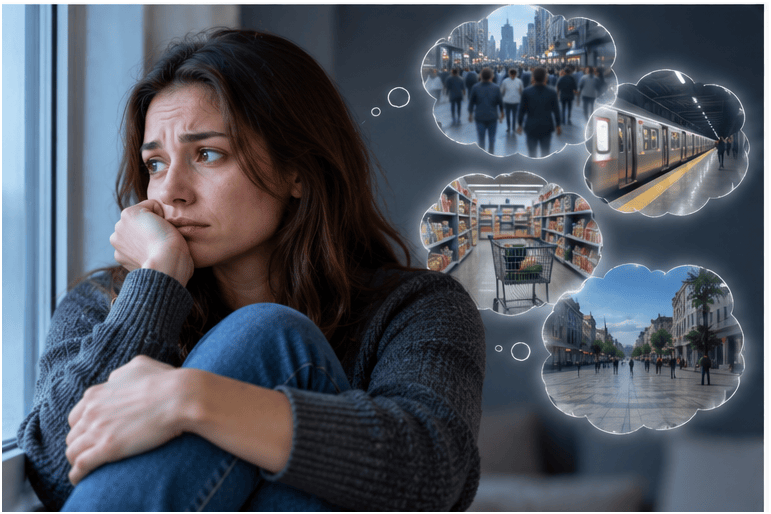
Situations associated with agoraphobic anxiety can include public transportation, crowded places, queues, shopping centres, cinemas, open spaces or being outside the home alone.
The specific situations vary from person to person.
Someone might comfortably walk around their neighbourhood but become extremely anxious about travelling several miles from home.
Another person may be able to travel when accompanied by someone they trust but feel unable to make the same journey alone.
For others, even stepping outside can become extremely difficult.
Understanding these individual patterns is an important part of therapy for agoraphobia.
How Can Agoraphobia Develop?
There is not one single experience that explains every case of agoraphobia.
However, panic and avoidance can play an important role for some people.
Imagine that you are standing in a crowded supermarket when you suddenly experience a panic attack.
Your heart pounds. You feel dizzy. Breathing becomes uncomfortable. You are frightened that you might collapse or lose control.
Eventually, the panic passes.
But the experience stays with you.
The next time you consider visiting the supermarket, you remember what happened.
“What if I have another panic attack?”
You decide not to go.
Your anxiety immediately decreases.
That relief can unintentionally reinforce avoidance. Your brain learns that avoiding the supermarket prevented the feared experience.
Soon, another busy shop begins to feel unsafe.
Then public transport.
Then crowded places generally.
This can create an anxiety-avoidance cycle in which avoiding feared situations brings short-term relief but strengthens anxiety over the longer term.
What Is Online Therapy for Agoraphobia?
Online therapy for agoraphobia is psychological support delivered remotely, commonly through video sessions or other secure digital communication.
Depending on the service, online therapy may also incorporate messaging, journals, worksheets, educational materials and exercises completed between sessions.
The purpose is not simply to reassure you that nothing bad will happen.
Instead, therapy can help you understand how thoughts, physical sensations, anxiety and avoidance interact.
You can then work on changing the patterns that are keeping the fear going.
Online therapy can be particularly relevant to agoraphobia because travelling to a therapist’s office may itself involve some of the situations a person currently fears.
Being able to begin treatment from home can remove this initial obstacle.
However, the ultimate purpose of therapy is generally not to make staying home easier.
Effective treatment often involves gradually increasing your ability to participate in situations and activities that anxiety has restricted.
How Does Online Therapy for Agoraphobia Work?
Therapy normally begins with understanding your individual experience.
A therapist may ask which situations you find difficult, what you fear will happen, whether you experience panic symptoms and what you currently do to manage your anxiety.
You may also discuss how the problem affects your work, education, relationships and independence.
This can help identify your particular anxiety cycle.
For example:
Situation: Taking a bus.
Thought: “I’ll have a panic attack and won’t be able to escape.”
Physical response: Rapid heartbeat, sweating and dizziness.
Behaviour: Getting off immediately or avoiding buses altogether.
Short-term result: Anxiety decreases.
Long-term result: Travelling by bus feels even more threatening.
Once this pattern is recognised, therapy can focus on changing it gradually.
CBT for Agoraphobia
Cognitive behavioral therapy, usually called CBT, is one psychological approach used for anxiety disorders including agoraphobia.
CBT examines relationships between thoughts, emotions, physical sensations and behaviours.
This is relevant because anxious interpretations can make physical sensations and situations seem more dangerous.
Imagine noticing that your heart is beating quickly.
One thought could be:
“My heart is beating faster because I’m anxious.”
Another could be:
“Something terrible is happening. I need to get out of here immediately.”
The physical sensation is similar, but the interpretation can influence what happens next.
The second interpretation may increase anxiety, making your heart beat even faster.
This can create a cycle:
Physical sensation → frightening interpretation → increased anxiety → stronger physical sensation → more fear
Online CBT for agoraphobia can help you recognise these cycles and develop different ways of responding.
Why Avoidance Can Maintain Agoraphobia
Avoidance makes sense when viewed from the perspective of immediate relief.
If going into a shop produces intense anxiety, staying home means you do not have to experience that anxiety.
The problem is what your brain learns from the experience.
Every time you avoid the shop, you lose an opportunity to discover that you might have been able to cope.
Avoidance can therefore reinforce the idea that the situation really was dangerous.
It may also spread.
A person might initially avoid one supermarket.
Later, they avoid all supermarkets.
Then shopping centres.
Then busy streets.
Eventually, they may feel safe only at home or when accompanied by a trusted person.
Understanding this process is an important part of online therapy for agoraphobia.
Exposure Therapy and Agoraphobia
Exposure-based approaches may form part of treatment for agoraphobia.
The word “exposure” can sound intimidating, but therapeutic exposure is generally designed to be structured and gradual rather than simply forcing someone into their most frightening situation.
A therapist may help you develop a hierarchy of situations.
For example, someone who fears public transport might identify several steps of increasing difficulty:
- Looking at pictures or videos of buses.
- Walking to a bus stop.
- Waiting at the bus stop for several minutes.
- Getting onto a stationary or quiet bus where practical.
- Travelling one stop with a trusted person.
- Travelling several stops with support.
- Taking a short journey alone.
- Gradually attempting longer journeys.
The exact steps would depend on the individual and treatment plan.
The purpose is to develop greater tolerance of anxiety and discover that feared situations and sensations can sometimes be managed without escaping.
Progress does not necessarily mean feeling completely relaxed.
Someone may still feel anxious while taking a bus but choose to take it anyway.
That can represent an important change.
Safety Behaviours and Agoraphobia
Avoidance is not always obvious.
Sometimes people enter feared situations but depend heavily on what psychologists may describe as safety behaviours.
For example, someone may only visit a shop if another person accompanies them. They might always stand close to the exit, repeatedly check their heart rate or carry particular objects because they believe they could not cope without them.
Safety behaviours can feel necessary.
Some may be reasonable or practical, while others may reinforce the belief that a situation would be dangerous without them.
Therapy can help identify which behaviours are genuinely useful and which may be maintaining anxiety.
Any changes should be approached thoughtfully and, where appropriate, with professional guidance rather than abandoning coping strategies abruptly.
When Should You Consider Online Therapy for Agoraphobia?
You do not need to wait until you are completely unable to leave home before seeking help.
Earlier signs can also be worth addressing.
You may want to consider professional support if fear is causing you to avoid places you previously visited, you need someone to accompany you on routine journeys or your activities are becoming increasingly restricted.
Other possible signs include frequently cancelling plans because of anxiety, avoiding public transport, experiencing intense fear in crowds or spending considerable time worrying about having panic symptoms away from home.
A particularly useful question is:
“Am I organising my life around avoiding anxiety?”
If the answer is increasingly yes, discussing the problem with a qualified professional may be worthwhile.
Why Choose Online Therapy for Agoraphobia?
Accessibility is one of the most obvious potential advantages.
For someone with agoraphobia, attending traditional therapy may require doing exactly what currently feels overwhelming: leaving home, travelling, entering an unfamiliar building and sitting in a waiting room.
Online therapy can allow the therapeutic process to begin without that initial journey.
This can be particularly useful when someone’s symptoms have already restricted their mobility.
There are practical benefits as well.
Remote therapy may eliminate travel time and make appointments easier to fit around work, family responsibilities or other commitments.
Being at home may also make it easier to talk openly during initial sessions.
But convenience should not become another form of avoidance.
If therapy is helping, the longer-term aim may involve becoming more capable of engaging with life outside the home rather than simply making isolation more comfortable.
What Can You Expect From Online Agoraphobia Therapy?
Initial sessions often involve assessment and goal setting.
Your therapist will want to understand what you fear, what you currently avoid and what you would like to be able to do.
Goals should ideally connect with your real life.
Instead of simply saying:
“I don’t want anxiety anymore,”
a goal might be:
“I want to shop independently.”
Or:
“I want to take my children to the park.”
Or:
“I want to travel to work without needing someone with me.”
These goals provide something practical to work toward.
Your therapist may then help you understand anxiety, identify unhelpful patterns and develop a structured plan for practising new responses.
Managing Panic Symptoms
Some people with agoraphobia are particularly frightened of panic attacks.
Panic can involve intense physical sensations such as a racing heartbeat, sweating, trembling, dizziness, nausea, chest discomfort or changes in breathing.
These sensations can be extremely frightening.
Therapy can help people understand how anxiety affects the body and how fear of physical sensations can sometimes intensify them.
For example, noticing your heart beating faster may cause you to think:
“I’m about to collapse.”
That thought produces more fear, which makes the physical sensations stronger.
Learning to recognise this process can reduce some of the fear surrounding anxiety itself.
However, physical symptoms should not automatically be attributed to anxiety. New, unexplained, severe or concerning physical symptoms should be appropriately assessed by a healthcare professional.
How Long Does Therapy for Agoraphobia Take?
There is no universal timeline for overcoming agoraphobia.
Some people may make progress relatively quickly with structured therapy, while others need longer-term support.
The duration can depend on the severity of symptoms, how long avoidance has been present, whether other mental health difficulties are involved and how consistently therapeutic exercises are practised.
Progress can also fluctuate.
You might successfully complete a journey one week and find the same journey much more difficult the next.
That does not necessarily erase previous progress.
Recovery is better measured over time.
Perhaps you are travelling farther from home. Maybe you can stay in a shop despite feeling anxious. Perhaps you require less reassurance from another person.
Small increases in independence can represent meaningful progress.
How to Get More From Online Therapy
Active participation is important.
Try to be open with your therapist about what you actually fear, even if those fears feel embarrassing or irrational.
Keep track of difficult situations between sessions.
Write down where you were, what you predicted would happen, how anxious you felt, what you did and what actually happened.
This can help you and your therapist identify patterns.
If your treatment includes gradual exposure exercises, consistency can be important. Avoidance has often developed over months or years, so changing established habits can require repeated practice.
It is also important to tell your therapist if something feels too difficult or if you do not understand the purpose of an exercise.
Therapy should be collaborative.
When Online Therapy May Not Be Enough
Online therapy can be useful, but it is not appropriate for every situation.
Some people may need in-person assessment, medical care, psychiatric support or a more intensive level of mental health treatment.
A qualified professional can help determine what type of care is appropriate.
Routine online therapy should also not be relied upon as emergency support.
If you are in immediate danger, feel unable to keep yourself or another person safe, or are experiencing an acute mental health crisis, seek appropriate emergency or crisis assistance.
Finding Online Therapy for Agoraphobia
If you are considering online treatment, look carefully at the service and professional providing it.
Consider the therapist’s qualifications and experience, particularly with anxiety disorders, panic and agoraphobia.
Ask what therapeutic approach is used.
If CBT or exposure-based methods are offered, you can ask how these approaches are adapted for online treatment.
You should also understand confidentiality, privacy practices, costs, appointment arrangements and what support is available between sessions.
Feeling comfortable with your therapist matters too.
Treatment may involve discussing fears you have hidden from other people and attempting situations that feel uncomfortable. A collaborative relationship can make that work easier.
Final Thoughts on Online Therapy for Agoraphobia
Agoraphobia can gradually make life smaller.
One avoided journey can become several. A frightening panic attack can create months of anticipation about having another one. Activities that once seemed ordinary can begin to feel impossible.
But avoidance does not have to determine what happens next.
Online therapy for agoraphobia can provide a practical starting point for understanding the relationship between fear, physical sensations, thoughts and avoidance.
Therapy can help you identify anxiety cycles, examine frightening predictions and gradually approach situations that have become difficult.
The goal is not necessarily to never experience anxiety again.
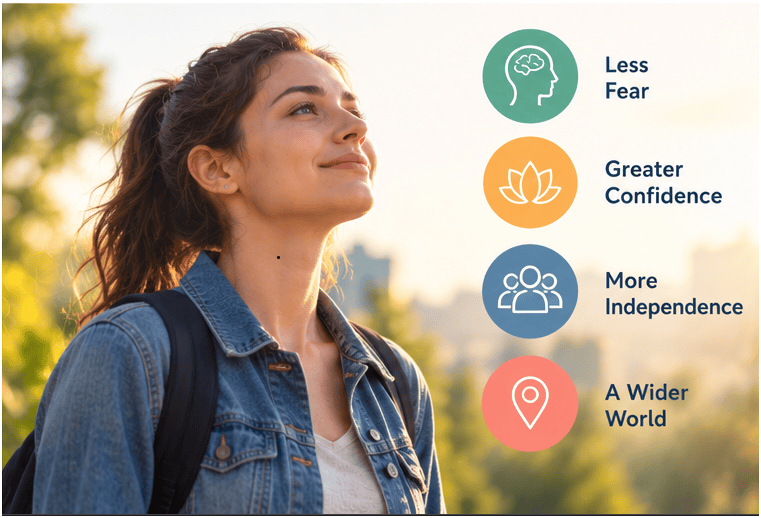
Instead, progress can mean being able to experience some anxiety without automatically allowing it to decide where you go, what you do or how independently you live.
For someone whose world has gradually become restricted by fear, reclaiming those choices can be one of the most meaningful aims of treatment.
Frequently Asked Questions About Online Therapy for Agoraphobia
Can online therapy help with agoraphobia?
Online therapy can provide structured psychological support for agoraphobia. Approaches may include CBT and appropriately planned exposure-based techniques. The most suitable treatment depends on the individual and should be discussed with a qualified professional.
Is agoraphobia just a fear of leaving the house?
No. Although severe agoraphobia can make leaving home extremely difficult, the condition can involve fear of various situations where escape or access to help feels difficult. This may include public transport, crowds, queues, open spaces or being outside alone.
Can agoraphobia involve panic attacks?
Yes. Some people with agoraphobia have experienced panic attacks and become afraid of having another attack in situations where they believe escaping would be difficult or embarrassing.
What is CBT for agoraphobia?
CBT examines relationships between thoughts, emotions, physical sensations and behaviours. For agoraphobia, it can help people understand anxious predictions and avoidance patterns and develop different responses.
What is exposure therapy for agoraphobia?
Exposure-based therapy involves gradually approaching feared situations in a structured way. Rather than continually escaping anxiety, a person can practise tolerating uncomfortable feelings and test predictions about what they fear will happen.
Can I start agoraphobia therapy without leaving home?
Online therapy can make it possible to begin treatment remotely. This can be particularly helpful when travelling to an office is currently difficult. Depending on the treatment plan, later work may involve gradually practising activities outside the home.
How long does it take to overcome agoraphobia?
There is no fixed timeline. Progress depends on factors such as symptom severity, how long avoidance has been occurring, other difficulties and the treatment approach being used.
When should I seek professional help for agoraphobia?
Consider seeking help when fear and avoidance begin restricting your activities, independence, relationships, education or employment. You do not have to wait until you are unable to leave home before discussing your symptoms with a professional.


Leave a Reply