


Relationships: How, When and Why They Matter

Introduction
Relationships are an important part of human life. From childhood through adulthood, people develop connections with family members, friends, partners, colleagues and others in their communities. These relationships can influence happiness, confidence, emotional wellbeing and the way people understand themselves and the world around them.
A relationship can be described as a connection between two or more people. Relationships take many forms, including friendships, family relationships, romantic partnerships and professional relationships. Although each type is different, healthy relationships usually involve communication, trust, respect, understanding and appropriate boundaries.
Romantic relationships are often given particular attention because they can involve strong emotions, commitment, intimacy and shared plans for the future. However, successful romantic relationships do not simply happen because two people are attracted to one another. They normally develop through communication, shared experiences, honesty and continued effort from both people.
Understanding how relationships develop, when a person may be ready for one, and why people choose to form relationships can help people make healthier decisions and build stronger connections.
What Is a Healthy Relationship?
A healthy relationship is one in which both people feel respected, valued and able to be themselves. This does not mean that the relationship will always be happy or that disagreements will never happen. Conflict is a normal part of relationships because two people will not always have identical opinions, needs or expectations.
What matters is how those disagreements are handled.
Healthy partners should be able to express their feelings without being frightened of the other person’s reaction. Both people should be able to say no, maintain friendships, have personal interests and make decisions about their own lives.
Trust is another important part of a healthy relationship. Trust develops when people’s words and actions are generally consistent. If someone repeatedly lies, breaks promises or hides important information, trust may become damaged. Rebuilding it can take considerable time.
A healthy relationship therefore involves both closeness and independence. Partners can support each other while still maintaining their own identities.
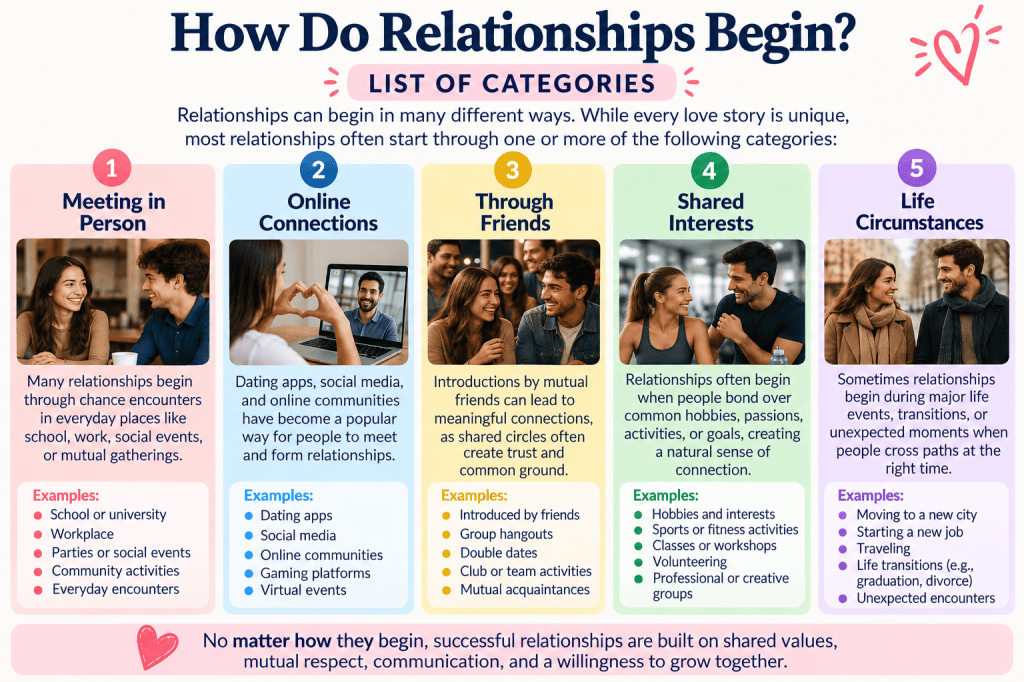
Relationships can begin in many different ways. Some couples meet through friends, education, work, social events, hobbies, dating apps or online communities. Other romantic relationships develop from existing friendships.
There is no single correct way for a relationship to begin.
Usually, a relationship develops because two people enjoy spending time together and become interested in learning more about each other. Attraction may initially be physical, emotional or based on shared interests and personalities.
As people spend more time together, they begin discovering whether they are compatible. They may learn about each other’s values, ambitions, family backgrounds, habits and expectations.
This stage is important because initial attraction does not necessarily mean that two people will be compatible in a long-term relationship.
For example, two people might be strongly attracted to each other but have very different expectations about commitment, children, money or where they want to live. Neither person necessarily has to be wrong. Their priorities may simply be different.
Communication helps people discover these similarities and differences before making greater commitments.
How to Build a Strong Relationship
Communication is one of the foundations of a strong relationship. Good communication involves more than simply talking. It also requires listening.
When someone discusses something important, their partner should try to understand what they are communicating rather than immediately preparing an argument or response. Asking questions and listening carefully can prevent misunderstandings.
Honesty is equally important. People should be able to communicate their feelings, concerns and expectations rather than expecting their partner to guess what they are thinking.
Respect is another essential element. Even during an argument, partners should avoid humiliation, threats, intimidation or deliberately cruel comments. Disagreeing with someone’s opinion does not require disrespecting them as a person.
Compromise is also necessary. Relationships involve two people with different preferences, so one person cannot always get exactly what they want. Healthy compromise means finding solutions that consider the needs of both partners rather than one person constantly sacrificing their needs.
When Should Someone Enter a Relationship?
There is no specific age or moment when everyone should begin a romantic relationship. People develop emotionally at different rates and have different circumstances, priorities and experiences.
Someone may be ready for a relationship when they genuinely want to share part of their life with another person rather than feeling that they must have a partner because their friends do.
Social pressure can sometimes make people feel that being single means something is missing from their life. However, entering a relationship simply to avoid being alone may result in accepting a relationship that is not right for them.
Emotional readiness is therefore important.
A person who understands their own boundaries, values and needs may be better prepared to communicate those things to another person.
It can also be useful to consider whether there is enough time and emotional energy available for a relationship. Relationships require attention. Work, education, family responsibilities or major personal difficulties can sometimes make maintaining a relationship more challenging.
This does not mean someone’s life has to be perfect before they can have a relationship. Very few people’s lives are completely free from stress. It simply means considering whether a relationship can be approached in a healthy and realistic way.
When Does a Relationship Become Serious?
There is no universal timetable for when a relationship becomes serious. For some couples, emotional commitment develops quickly. For others, it develops gradually over months or years.
A relationship often becomes more serious when partners begin making decisions with each other in mind.
This might involve meeting each other’s families, planning holidays together, discussing exclusivity, sharing responsibilities or talking about future goals.
Communication becomes particularly important during this stage because people sometimes assume that their partner has the same expectations without discussing them.
For example, one person might consider the relationship exclusive while the other believes they are still casually dating. A straightforward conversation about expectations can prevent significant confusion and hurt.
More serious decisions, such as moving in together, marriage or having children, deserve careful discussion. These decisions can have financial, emotional and practical consequences and should not be treated simply as automatic stages that every relationship must reach.
Why Do People Want Relationships?
One major reason people form relationships is emotional connection.
Humans are social beings. Many people want someone with whom they can share their thoughts, feelings, achievements and difficulties. Being understood by another person can provide a powerful sense of belonging.
Romantic relationships can also provide companionship. Everyday experiences can become meaningful when shared with someone important. This might involve travelling together, cooking, watching television, going for walks or simply talking at the end of the day.
Love and affection are other important reasons. Romantic relationships can provide emotional and physical closeness that is different from many other relationships.
However, romantic relationships are not the only source of meaningful human connection. Friendships, family relationships and community connections can also provide belonging, support and companionship.
Relationships and Personal Growth
Relationships can teach people a great deal about themselves.
Being close to another person can reveal personal strengths and weaknesses that might otherwise be difficult to recognise. Someone may discover that they struggle to communicate when upset, become defensive during criticism or avoid difficult conversations.
A supportive relationship can provide an environment where both people learn and grow.
Partners can encourage each other to pursue education, careers, hobbies and personal goals. They can celebrate achievements and provide encouragement during setbacks.
Growth should not mean trying to transform a partner into a completely different person. There is an important difference between supporting someone’s development and constantly criticising them because they do not match an imagined ideal.
Healthy partners generally encourage one another while respecting each other’s individuality.

Trust and Loyalty
Trust can take months or years to develop but can sometimes be damaged very quickly.
It is built through repeated experiences of honesty, reliability and respect. Keeping promises, communicating openly and respecting agreed boundaries all contribute to trust.
Loyalty is also important, although couples may define it differently. This is why boundaries should be discussed rather than assumed.
For some people, certain interactions with other people might feel completely acceptable, while their partner may consider them inappropriate. Talking about boundaries allows couples to understand what each person expects.
Trust should not be confused with control. Constantly checking someone’s phone, demanding passwords, monitoring their location or preventing them from seeing friends is not automatically evidence of love or commitment.
A strong relationship allows people to remain individuals as well as partners.
Handling Arguments
Every relationship will experience disagreement at some point.
Arguments themselves do not necessarily indicate that a relationship is unhealthy. The important issue is how disagreements are managed.
Healthy conflict focuses on the problem rather than attacking the person.
For example, saying that a particular action was upsetting is different from insulting someone’s personality. Calmly explaining a concern creates a better opportunity for resolution.
Sometimes emotions become too intense for a productive conversation. Taking some time to calm down can help, provided the issue is eventually discussed rather than permanently avoided.
Apologising is also important. A meaningful apology involves recognising what happened, understanding its effect and trying to behave differently in the future.
Both people should be willing to take responsibility when appropriate.

Boundaries and Independence
Boundaries define what a person is comfortable and uncomfortable with. They can involve physical affection, privacy, communication, money, friendships, family involvement, sex and many other areas.
People have different boundaries, and these should be respected.
Consent is especially important in romantic and sexual relationships. Being someone’s partner does not create automatic entitlement to physical or sexual contact. Consent should be freely given and can be withdrawn.
Healthy relationships also allow independence.
Partners do not need to spend every moment together or share every interest. Maintaining hobbies, friendships and personal time can actually strengthen relationships because both people continue developing as individuals.
Depending entirely on one person for emotional support can place considerable pressure on a relationship. Maintaining other healthy connections can create a more balanced life.
When Relationships Become Difficult
Relationships naturally experience challenging periods. Financial difficulties, work stress, illness, family problems, parenting responsibilities and major life changes can all create pressure.
During difficult periods, communication becomes particularly important.
Instead of viewing each other as opponents, couples can try to identify the problem they are facing together. Sometimes practical changes can reduce tension, while other difficulties require patience and emotional support.
Some couples choose relationship counselling when they struggle to resolve recurring problems. Seeking support does not automatically mean that a relationship has failed. It can provide a structured environment for discussing difficult issues.
However, not every relationship should necessarily continue.
When Might a Relationship Need to End?
Relationships sometimes end because people change, circumstances change or important differences become impossible to resolve.
A relationship ending does not automatically mean that it was meaningless or unsuccessful. A relationship may have contained genuine love and positive experiences while still reaching a point where continuing is no longer appropriate.
Persistent dishonesty, incompatible future goals, repeated boundary violations or a complete breakdown in trust can lead people to reconsider a relationship.
Abuse is more serious. Physical violence, sexual coercion, threats, intimidation, stalking, extreme control and emotional abuse are not normal relationship disagreements. Safety should take priority in these situations, and specialist support may be necessary.
People should not feel obligated to remain in a relationship simply because they have invested significant time in it.
Why Healthy Relationships Matter
Healthy relationships can provide emotional support during both positive and difficult periods of life.
Having someone who celebrates achievements, listens during difficult moments and provides companionship can make life’s experiences feel less isolated.
Relationships can also create shared memories and traditions. Birthdays, holidays, ordinary evenings and major milestones can become part of a shared history.
For some couples, relationships eventually develop into marriage, family life or long-term partnership. For others, a meaningful relationship may take a different form. There is no single model that everyone must follow.
What matters is whether the relationship works for the people involved and whether both individuals are treated with dignity and respect.
Maintaining a Relationship Over Time
Starting a relationship and maintaining one are different challenges.
The excitement experienced at the beginning of a relationship naturally changes over time. As people become familiar with each other, everyday responsibilities become a larger part of the relationship.
Long-term relationships therefore require continued attention.
Making time for each other, expressing appreciation, showing affection and maintaining honest communication can help preserve emotional closeness.
Small actions can be surprisingly important. Asking about someone’s day, remembering something important to them, helping when they are overwhelmed or simply saying thank you can demonstrate care.
Relationships also need flexibility because people change throughout life. Careers develop, priorities shift, families change and individuals gain new experiences.
Strong relationships often involve learning how to adapt to these changes together.

Conclusion
Relationships are complex because people are complex. There is no perfect formula that guarantees that two people will remain together forever. However, certain qualities consistently help create healthier connections: communication, honesty, trust, respect, consent, boundaries, compromise and mutual effort.
Understanding how relationships work means recognising that strong connections are built through everyday actions rather than feelings alone. Love may begin a relationship, but communication, reliability and respect help sustain it.
Understanding when to enter or progress a relationship means considering emotional readiness, personal circumstances, compatibility and shared expectations rather than following pressure from friends, family or society.
Understanding why relationships matter involves recognising the human need for connection, companionship, affection, support and shared experiences.
A healthy relationship should add something meaningful to the lives of both people without requiring either person to lose their independence or identity. Partners will sometimes disagree and experience difficult periods, but both should continue to feel respected and able to communicate.
Ultimately, relationships are not simply about finding another person. They are about learning how to build a connection in which two individuals can communicate honestly, support each other, respect boundaries, share experiences and continue growing both together and independently.


Leave a Reply